after seventeen years
underground in a brittle
brown shell, emerging
white into the light, turning
black, singing all day
The last time we saw them was in 1997. After seventeen years as nymphs buried a few feet deep in the ground in wooded areas here in southeast Iowa, the red-eyed cicadas have emerged once again, in huge numbers, as is usual with this species. They have tunneled up and popped out over just a few days in the last few days of May and the first few days of June. What would it be like to live your entire life in the dark and then suddenly see the light? John said when he was digging the foundations for our wind turbine tower, he uncovered some strange grub that poked its head out of a hole and then quickly withdrew back into its tunnel, where it would continue to suck on rootlets.

I am walking on the path from the house when I notice an anomaly in the grass. It's a cicada in the process of molting from its brown husk out of a split in the back.

For half an hour I watch in fascination as it descends, hanging head first, and appears to sprout tiny dragon wings.

It looks like a white shrimp with bright red eyes and black Groucho Marx "eyebrows."
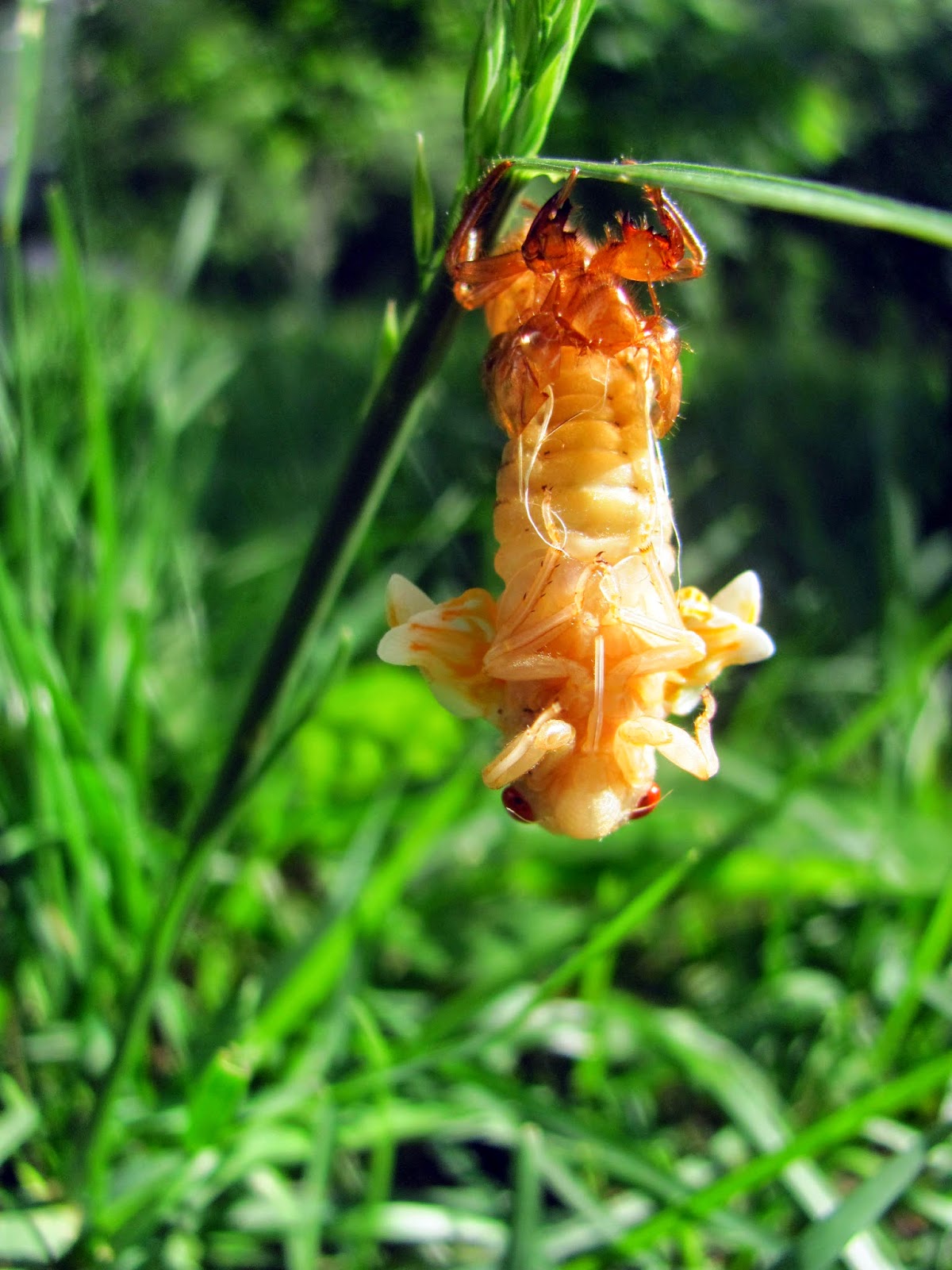
The underside of the wings are marked with golden veins.

Suddenly it falls all the way out of the shell, which it clings to with its front legs.

There it hangs while its translucent white wings slowly unfold.

Magically growing longer.

And longer.

Beautifully veined, like opalescent glass windows.

After the wings are fully grown, the cicada closes them against its back, which is beginning to darken.

Finally, it descends to the grass, completely transformed in color, the wings and legs now coppery, the body completely black, hiding the "eyebrows."

The inside of the abandoned shell.

The next day the yard is full of empty shells.

One pair looks like conjoined twins.

The underside of hickory leaves are full of nymph shells and holes chewed by the adults.

Some of them cling to an old handkerchief on the clothesline. No, those holes were not made by chewing insects!

When I was a child, my father would stick a cicada shell to my shirt, where it would cling like some kind of alien jewelry. At first I was terrified by the goggle eyes and hooked feet, but when I saw that it was just an empty shell, I came to enjoy wearing them as fragile pins.

My cicada is still right where I left it, clinging to a grass stem. It takes a few days for the exoskeleton to completely harden and during this time the cicada doesn't move around much.

Sometimes the molting doesn't proceed properly. One cicada on a fence post hasn't flown away from its empty shell nearby because one of its wings dried in a distorted way. It will have to crawl to eat. It appears to be a male, since its abdomen is rounded rather than having a pointed ovipositor, so it's not likely to find a mate.

There are other hazards. A hapless cicada, perched on the rim of a bowl of water, falls in when our cat comes for a drink.

But Ginger is not interested in floating bugs and just laps water around it, so I'm able to use a leaf to rescue the cicada.

By the pond I find dozens of cicadas. They seem to prefer blackberry bushes.

And multiflora rose bushes.

On one bush I count 30 cicadas. The male "sings" by rubbing its wings against the tymbals on its body, an incessant chirring that sounds a bit like our wind turbine turning at medium speed. In between bouts of choruses, the males fly around in search of females. Once mated, the female inserts her eggs into a living stem. By the time the eggs hatch and the ant-sized nymphs fall to the ground and burrow, the adults are all dead. Strange life indeed.

Two weeks later, the waves of scintillating sound continue all day. The air is filled with copper wings and the little trees in our orchard are encased in cicadas. When the sun goes down, the cicada chorus is replaced by the frog chorus in our neighbor's pond across the road.

The only time they stop singing during the day is during a rainstorm, which we've had quite often this spring.

While I am taking photos in the orchard, a cicada lands on my left hand and starts crawling. Interesting acrobatics, trying to focus and take a photo of a moving object with one hand. But this gives a good idea of its size. Once a cicada landed on John and he inadvertently carried it into the car on his sleeve. What a racket it made in the closed vehicle! John rolled down the window and stuck his arm out, but it clung to his shirt until he brushed it off.

By the third week in June, some of the cicadas are showing wear and tear in the wings.

Although this one is still able to fly.
Another cicada is not so lucky. Finding it on the path by our front door, I carefully pick it up by the wings and place it on a tree. To my horror I see that it has only a head and legs, which are still moving, but no abdomen. When I return to the house, I see its black bottom on the rim of the granite bird bath, flattened, flacid. What on earth happened? With a little internet research, I discover that there is a fungus, Massospora cicadina, which spreads during cicada mating and destroys the the insect's entire abdomen within days. What a bizarre way to go.
If a cicada doesn't get eaten instantly by a bird, opossum, snake, turtle, frog or spider, it may die a slow death from a sexually transmitted fungus. So the periodical cicadas' main defense, since they don't bite or sting or taste nasty, is to hide out underground for seventeen years and then emerge in overwhelming numbers so that enough survive above-ground perils to reproduce. Maybe that's why each cicada sports a mark near the tip of its wings: W for WE WIN.

By the third week in June, besides the continuing din, many trees and shrubs along the road and in the woods show signs of "flagging," where the twigs and leaves on the tips die and hang down like sad brown flags. This is caused by cicadas feeding on the leaves or laying eggs on the twigs. Apparently, this doesn't seriously harm mature trees and shrubs, though I'm glad I didn't plant any new trees in our orchard. Perhaps the flagging functions as a kind of pruning. In any case, I don't begrudge the periodical cicadas their food. They, in turn, will soon die and fall to the ground under those same trees and shrubs, providing them with fertilizer. And so the cycle of life continues.