Showing posts with label May Apple. Show all posts

Sunday, April 24, 2016

curving back on red


curving back on red 
stem, lily petals rocket
from yellow stamens

The angel wings of Duchman's Breeches have flown away. Where they touched the earth, pink and white Spring Beauty polka-dot the ground.


Interspersed among them, Sweet William, Bluebells, and Violets in shades of deep purple, magenta, pale lavender and bright yellow.

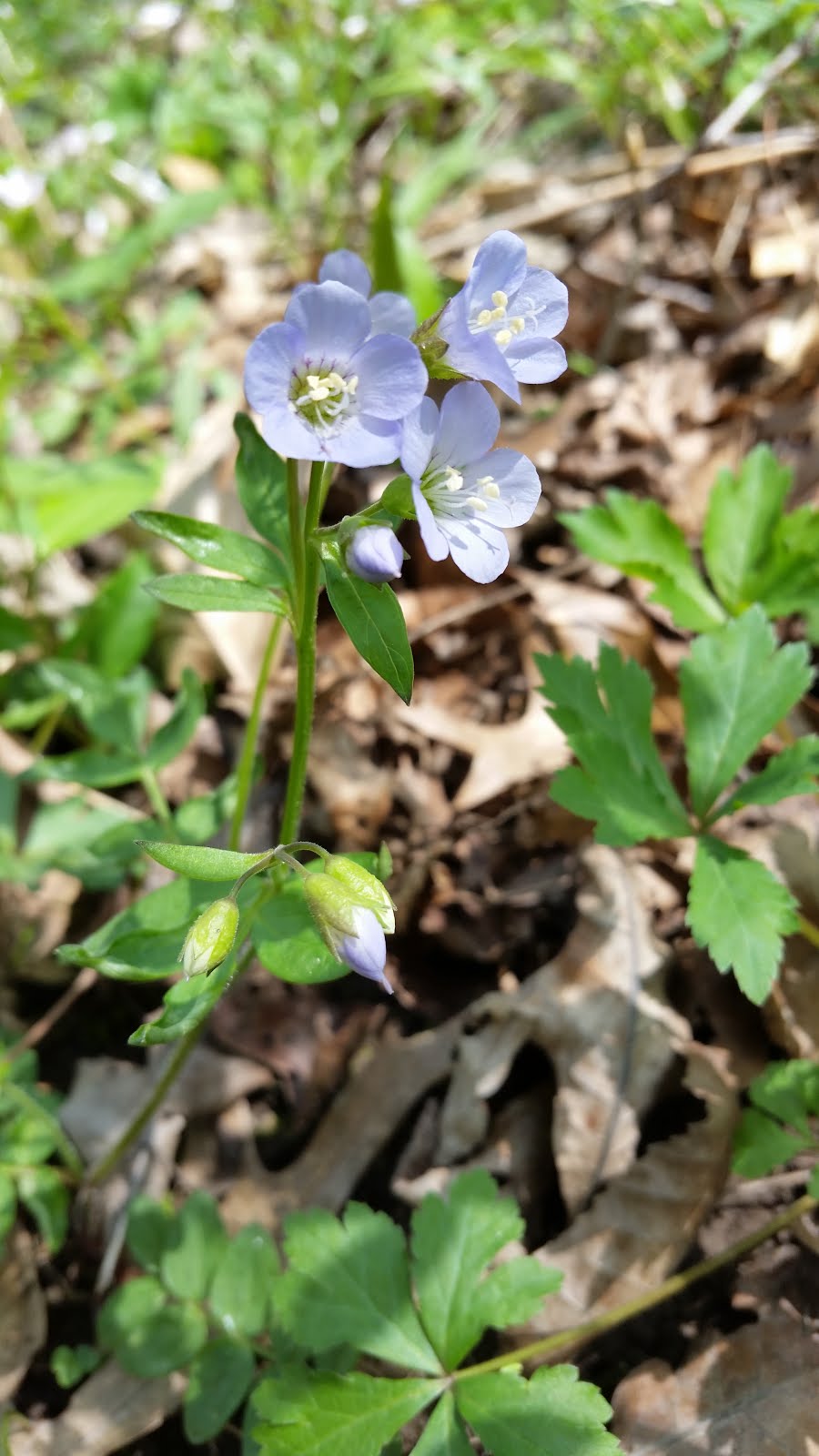


In the wooded hills dipping down to Pilgrim Creek, the shade-loving wildflowers are in bloom -- Red Trillium with their three splotched leaves and three burgundy petals, white Trout Lilies like shooting stars, white Anemones with their scalloped leaves, and glossy Buttercups with fringed leaves.


Trout Lily is a strange name for a flower that looks like a shooting star. Erythronium's common name is based on the appearance of the leaf, shaped like a speckled trout. Some of the plant's other common names are equally odd -- Adder's Tongue, Dog's-tooth Violet. Fawn Lily comes closest to describing the graceful blossom with its spotted leaves.


One entire hillside looks like a green sea with shiny waves -- the dark green umbrellas of May Apples glinting in the sunlight, each single lime-green flower bud curving down from the junction of its pair of protective leaves.


The Wild Plum blossoms are fading, but now the Redbuds are in bloom, their small pink flowers popping like pompoms directly out of the bark, with baby heart leaves at the tips of stems. Our neighbor's honeybees are hard at work with all this bounty of blossoms.


Now the Buckeye flower buds have opened. On the Ohio Buckeyes (Aesculus glabra) with green leaves and chartreuse flower cones, tubular yellow blossoms sport curvy white filaments tipped in orange that extend fan inch beyond the lips of the flowers, giving the long cone a bottlebrush appearance. On the Red Buckeyes (Aesculus pavia) with rosy racemes, the clusters of blossoms are cherry red.


Sadly, many of the Buckeyes down by the creek have wilted leaves. Not yellow or brown-edged, just dark green and drooping. It's the first time in the two decades we've lived here that I've ever seen this. We've had plenty of rain, so it could be a reaction to too much moisture in the soil. I hope it is not a wilt leaf disease of some sort, perhaps caused by the soil fungus, Verticillium. So far, the five young trees growing on high ground near our house show no signs of leaf wilt. But it would be a major loss if the creek's stately stand of Buckeyes died. But what to do? Wait and watch, so often the only thing that can be done.

Sunday, April 17, 2016

a host of angel wings


a host of angel wings 
ascending from the earth
from where they arose

The woods are filled with bright blossoms. Dutchman's breeches sprinkled everywhere under the trees, like spring snow. To me they look more like little lanterns with yellow flames swaying from red poles or like angels ascending, or maybe descending, on white or pink wings.


A small woodland flower with clusters of white bells flourishes among the dutchman's breeches, adding more spots of white to the dark leaf litter.


The wild plums are in full bloom, their fragrant scent wafting on a warm breeze as I walk to the mailbox.


Colonies of may apples poke their green skull buds up between the hunched green shoulders of their cloaking leaves.


The leaves undergo fantastic contortions as they unfold.


One may apple wears an oak leaf as a parasol.


Pale green-gold plumb bobs dangle from a hazel bush amidst the baby leaves.


On another understory tree, fantastic gold and red tassels drape along the twig below a fanfare of new leaves at the tip.


But this intrepid plant, literally busting a chunk of hard road clay, takes the prize for determination to grow.

Wednesday, April 22, 2015

May apple parasols


May apple parasols
spring up from the moist earth
pop open green hands

This Earth Day, we are replacing our cedar shake roof with metal shingles, exchanging endangered wood for recycled metal. We counted over a hundred growth rings on one of the thick, hand-split shakes. You can't find big trees like that anymore. And after 25 years of snow, ice, rain, sun and wind, the shakes are etched with lichens, carpeted with moss and split by the elements.


We have a great team of roofers. Jim stands about 5' 2" and weighs maybe 100 lbs. without his tool belt. Craig towers about 6' tall and weighs around 250 lbs. Jim works in the air, gamboling around the sloping roof like a mountain goat, occasionally using a thick turquoise rope like a rock climber. Craig works on the ground, carting 40 lb. sheets of fir plywood like an ox. 
          Jim warned me the first day: "If you have any flowers around the house, they're going to get smashed." Of course, my daffodils are all in full bloom and my irises and lilies are in full leaf. Sure enough, the first thing the roofers do is lay down tarps to catch the shingles. I'm in the kitchen when I see shingles showering down on my Ornamental Plum bush, which is covered with cotton candy blossoms, shattering petals in the air like pink snowflakes. I run out to the bush with a tarp. (Knowing this might happen, I took a photo of the bush before the roofers arrived.)


Jim wields a kind of flat shovel to pry the shingles off. 


Craig stands at the top of the ladder to scoop them off the roof onto the tarp, while Jim pounds down the staples in the old tar paper underlayment. 


Craig drags the tarp full of shakes over to a spot under a tree, thankfully past the colony of May Apples which have just raised their green parasols, and dumps them in a pile on top of the quilt of Spring Beauties and Violets. I cart load after load of broken shakes from the yard to the woodpile. "Why not leave them there?" Craig asks. "Because it's unsightly," I reply. "This is our main view from the house." And besides, my miniature daffodils are due to come up under that very tree in a matter of days.
          After Jim has cleared off a section of old shingles and tacked down the black waterproof sheeting, Craig totes a sheet of plywood from the pile and slides it up the metal ladder to Jim (John helps whenever he can). Jim lifts the 4' x 8' sheet up all by himself, wrestles it around and plops the decking into place, then staples it down with an air gun. Jim raises cattle when he's not roofing (he's done both for 40 years), and I can imagine him wrangling a steer down single-handed for branding. Craig taught middle school physical education for 40 years, and I bet he could subdue a rambunctious adolescent with one hand, held at arm's length.
          

We live in a timber frame house with walls of clay mixed with straw and stone floors. Now we will add another earth element, metal, to our earthy house. This roof will last for hundreds of years, maybe longer than the house itself. And then, if the metal isn't recycled by some future generation of humans, it will simply sink back into the Earth from whence it came.

Wednesday, April 25, 2012

under the unfurled


under the unfurled
green umbrellas a single
white blossom curves down

By mid-April the May Apples are in bloom, but you have to peer under the canopy of green umbrellas to see the singular white blossoms sheltered below. Each flower has seven petals, matching the seven lobes of the leaves. The blossom curves down on a slender "neck" between the two upraised "arms" of the pair of leaves, coyly waiting for a pollinator to visit her golden heart.

a pair of furled green


a pair of furled green 
umbrellas slowly open
their seven-lobed leaves

May Apples began emerging in March, pushing up through the litter of last year's leaves, sometimes pushing through a dead leaf, the strength of living sap pitted against brittle cellulose.


The new shoot looks like a furled green umbrella.


At the top of the umbrella, a pale green flower bud appears. At this stage plant with its unfurled leaves below the bud looks like a little wood gnome wrapped in a green cloak.


This one looks like a bald monk holding a robe up around his ears.


When fully open, each scalloped leaf has seven deep lobes.


In our sunny meadow, May Apples grow into a colony, like a plaza crowded with green parasols.