Showing posts with label Oshino. Show all posts

Wednesday, August 7, 2013

in the predawn twilight


in the predawn twilight
girdled in pilgrim white 
fujisan's bare crown 
emerges blue on pale blue
awaiting the waking sun

Waking at 4, I open the shoji for my first view of the day. In the pale blue crepuscular light before the sun peaks over the mountains at my back, Fujisan seems to be sleeping under a white cotton sheet, bare crown emerging above a bank of clouds girdling her base. Midsummer, only a couple of white smears of snow, like a streak of white hair, lie in a crevice along one slope. The white-garbed pilgrims, climbing through the night to reach the peak by dawn, stand breathless, awaiting the first brilliant burst of sunlight.

Tuesday, February 21, 2012

white smoke billowing


white smoke billowing
from the crown of Fujisan --
fan of cotton ball clouds


Looking like puffs of white smoke rising from the still-active volcano, a swath of altocumulus cloudlets curves up from the top of Fujisan's cone.

Saturday, January 14, 2012

beyond the snow bowed


beyond the snow bowed
black pines, nebulous blue twilight,
Fujisan's presence

First act on awakening, open shoji, greet Fujisan. This morning, fog, a nebulous blue obscuring the space beyond black pines bowed with snow. Fujisan's presence, hidden, yet ever present.

Friday, January 13, 2012

strolling through a garden


strolling through a garden
cloaked in snow, feeling the space
between dark and light 

Gentle flurries of snow continue to fall the day after the blizzard, individual flakes rising up in spirals near the house. The scenery reminds me of the snowy month I spent in Japan. In the little town of Oshino at the foot of Fujisan, Kaneyama Hotel has a lovely strolling garden with tea rooms perched on the banks of a mountain stream, Kaneyama, which feeds into the larger Hirayama near Sensei's house. 
          As we wander through the snow-covered garden, I am intrigued by the rope tipis placed over each black pine to protect it from the heavy snow, and the woven trunk guards to protect the tree from insects -- such careful attention to the welfare of every object, animate and inanimate. A group of stones in the central pond look like they are soaking in a hot springs. A waterfall cascades over boulders bordered by shiny holly into a little basin where a bamboo ladle beckons you to bend down, wash your hands and cleanse your mouth with the clear mountain water. Everything looks completely natural, yet it's all carefully arranged. 
          Sensei tells us that it is not just the arrangement of trees and stones and water that makes the Japanese garden, but ma, the space between objects. Each gap creates an interval of time between thoughts and feelings that defines the experience, then releases it. "Ichi go ichi e," she says, "one time, one meeting." This phrase is particularly significant for the tea ceremony. Every moment is unique and fleeting, so savor it and then continue on the path.

Friday, July 29, 2011

snow muffles the stones


snow muffles the stones
while the taki falls free, always 
changing, always there

We wander through a lovely garden behind a large hotel in Oshino, a popular place for weddings in the summer. Now it is quiet and empty. Thick snow muffles the stones and plants like kakebuton stuffed with mulberry silk. The water in the taki murmurs in a primordial tongue as it drops between the boulders overhung with holly and cedar. The large bamboo hishaku resting on the edge of a small pool is an invitation to bend down, wash the hands and rinse the mouth, as one would do before entering a tea house or shrine. However, the coins lining the bottom of the pool signal that this is more of a wishing well than a formal tsukubai. When I sit and listen to the waterfall running freely in the midst of winter over the silver and copper coins, it seems to be ceaselessly babbling, "permanent, impermanent, permanent, impermanent."

Thursday, March 17, 2011

soft blue morning sky


soft blue morning sky –-
Fujisan rising above
a wreath of white clouds
 
Early morning before sunrise, the sky a soft blue, the mountain a deeper shade of blue highlighted with pale blue snow, wreathed with a garland of bluish-white clouds, and then the dark green, almost black pine trees in the foreground, providing contrast. The whole scene feels like the first vision of the quest mountain.

Tuesday, March 15, 2011

Fujisan's summit


Fujisan's summit
obscured by a hawk-eagle
cloud bringing snow

I took this photo of Fujisan during my last visit to Japan. It reflects how I'm feeling about the plight of the Japanese people following the earthquake and tsunami. I still have not heard from my friend Hiroko Goto, who lives at the foot of Fujisan. Hoping she's okay.

Tuesday, February 15, 2011

late winter -- Fujisan


late winter –- Fujisan
under a white kasa framed
by open shoji
 
Fujisan looks like a lady carrying a white paper kasa to protect her face from the sun. The dark mountain half-covered with snow, the dark pines in front of the house, and the shoji with hinoki frames covered with white washi create a sublime contrast of dark and light.

Wednesday, February 9, 2011

cold cloudless morning


cold cloudless morning –
Fujisan red veiled in white –-
fire sleeping inside
 
One of my favorite prints by Hokusai, Hodogaya on the Tokaido Road, is often called “Red Fuji.” I used to think the artist took liberty with the color of the mountain. But when I first saw Fujisan on a cold, cloudless morning, red veiled in white, I realized that red is the mountain’s true color. Hiking on the mountain, I slogged through loose brick-red volcanic rock. The frothy scoria looks like little dark red sponges. The red is due to weathering of the basalt layer, which was most recently laid down 10,000 years ago. Fujisan last erupted in 1707-08, so she is not considered an active volcano. But in Japan, nothing is certain.

Sunday, February 6, 2011

Fujisan at sunset


Fujisan at sunset
capped by a fish-shaped pink cloud
surfing the jetstream

During a magical sunset, this lens-shaped cloud forms and transforms in shape and color directly over the peak of Fujisan. Like a fish with a pink body and white tail, it hovers in the same spot during the entire sunset. I keep vigil over its lovely shape-shifting from small pinkish blur to large pink fish to small gray smudge until I can no longer see it in the dark. 
          This saucer-shaped cloud, sometimes mistaken for a UFO, is an altocumulus lenticularis, which forms at the crest of waves in the moist airstream above raised ground such as a hill or mountain peak. Unlike most clouds that drift along with the wind, these stay in the same position as long as the airstream remains fixed.

Monday, January 31, 2011

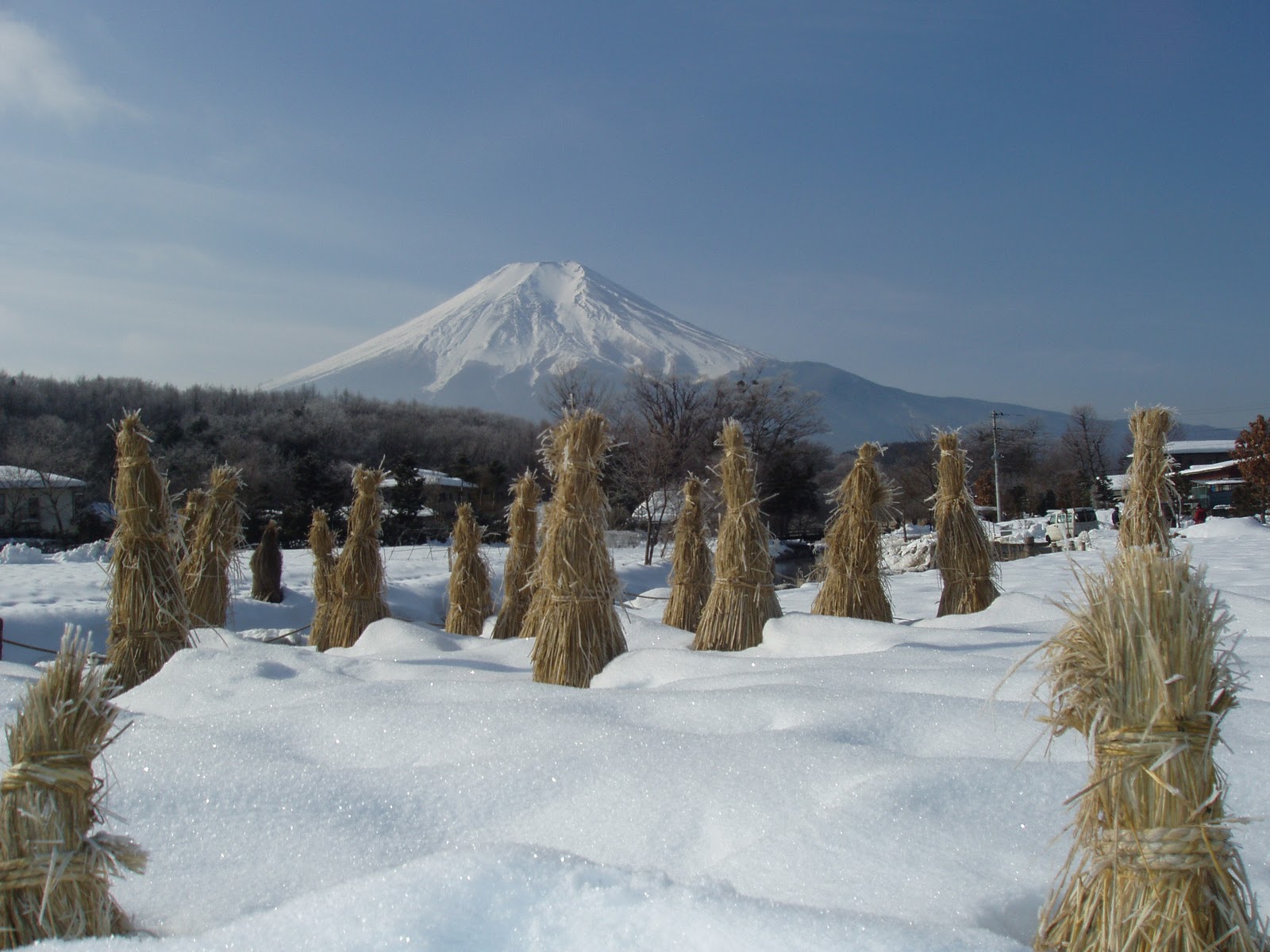
straw stacks sunk in snow


straw stacks sunk in snow –-
rising above the small peaks
Fujisan, cloaked in white

I am not the only photographer charmed by this scene. The parking lot next to this little field bristles with as many tripods as straw stacks. I am the only foreigner taking photos and I have no tripod, but I feel right at home. The scene reminds me of Hokusai’s Thirty-six Views of Mt. Fuji, particularly Tea House at Koishikawa, the morning after a snowfall. I fell in love with ukiyo-e artist Katsushika Hokusai at an early age and my house is filled with his beautiful colored woodblock prints. During my stay in Oshino, at the foot of Fujisan, I understand how a person could spend every day admiring the beauty of this magical mountain from many different viewpoints and through all the changing seasons.

Sunday, January 30, 2011

Fujisan under snow


Fujisan under snow –
an ice sculpture kneels beside
the pilgrimage road
 
Sensei’s house sits on the side of a small mountain with a view of Fujisan. Often I walk down the steep, winding road to the river. Ice sculptures line the road, looking like pilgrims dressed in white, suspended in ice, waiting for spring to release them so they can continue their pilgrimage.

Tuesday, January 25, 2011

Fujisan's peak


Fujisan’s peak
engulfed by cloud –- or mountain
engulfing cloud –- both
 
For one month in early 2005 I stayed at the home of my friend Hiroko Goto, who lives at the foot of Fujisan, the sacred mountain. My room was on the second floor, a beautiful traditional Japanese room with tatami, futon and no heat. Every morning I slipped out from under layers of quilts to slide open the shoji and greet Fujisan. And every morning she showed me a different face.