Showing posts with label Xcaret. Show all posts

Saturday, April 21, 2012

flying upside down


flying upside down
Voladores de Papantla
worship the sun god


We're sitting on the top row of a little amphitheater in Xcaret, waiting for the show to begin. Xcaret, which means "small inlet" in Maya, is an eco-archeological theme park on the Yucatán Riviera that combines elements of Disney World with National Geographic. This afternoon we've joined a small crowd to watch Voladores de Papantla, "flyers of Papantla," perform a ceremony to the sun god. Four of the men, the flyers, represent the elements of earth, air, fire and water, while the fifth man represents the unifying element of space. 

         
          The men, dressed in colorful costumes and playing traditional rattles, drums and flute, march in a row into the open space below a large pole 30 meters (almost 100 feet) high and as big around as two men, set in a wide stone foundation. They dance around the pole, shaking rattles. 


          One of the men plays a small wooden flute held in his left hand along with a small drum, which he is beating with his right hand.
        
          
          One by one they begin to climb the pole, placing their feet on narrow foot rests set on alternate sides and grasping a thick yellow rope that's wrapped around the poles at intervals. 


          As each one reaches the top, he sits on a narrow bar forming one of the four sides of an open square painted red, green and white. They hang onto the bar, their legs dangling down.


          The fifth man mounts a conical spindle in the middle, wrapped round and round with the yellow cable. He wraps his legs around the spindle, leaving his hands free for his musical instruments. The four flyers begin leaning out and throwing their weight to one side, causing the platform to rotate, while the musician, perched on top and hunched over like an eagle, plays his flute and drum.


          Suddenly the four flyers simultaneously lean all the way back and drop upside down off the platform, arms spread wide, the ribbons on their headdress streaming behind them. Each flyer is suspended only by a yellow rope looped around the body. One foot is hooked around the rope while the other foot hangs free. 


          While the musician continues to play, I find myself holding my breath as the flyers slowly descend, circling wider and wider until they near the ground. Then, like the acrobats they are, they miraculously right themselves to land on their feet.


          But what about the musician in the eagle's nest? While one of flyers holds his rope at an angle from the pole, the musician lowers himself down the cable. I finally start breathing when he reaches the ground and the crowd applauds.


          But they're not done yet. On one side of the area there is a low wooden windmill with four blades, painted red, green and white. The four flyers don their large solar headdresses and mount the four blades, hanging onto pegs. Again, they use their bodies to begin rotating the windmill, which rotates slowly. While the musician pipes and drums, each flyer moves from face up to head up to face down to head down. 


          Finally, they all dance around the windmill and then bow to the applause of the enchanted audience.


          Some of their colorful fringed scarves and headdresses, decorated with flowers, ribbons, rainbow fans and circular mirrors.

Wednesday, April 18, 2012

unfolding gangly


unfolding gangly
black limbs a spider monkey
stands fully erect

The little black ball of fur in the open enclosure at Xcaret is clearly a monkey. While I watch, he pops something in his mouth with his agile fingers. Then he begins to unfold like origami. First he comes to his hands and feet, his thin arms and legs elongating, and now he does look like a four-legged black spider. Then he starts to stand on two legs, bent over like an old man. Finally he stands fully upright, looking like a gangly teenager, peering over his shoulder. When I look at what he is looking at, a barefoot toddler is walking by. I imagine the spider monkey thinking, "Sure, she can walk on two feet, but can she swing through the trees?"

Tuesday, April 17, 2012

with rattles and drums


with rattles and drums
Maya musicians shake and beat
their pulsing rhythms

Like the ritual dancers at Xcaret, the Maya musicians are wearing paint, feathers and elaborate costumes. With their ancient musical instruments -- rattles and drums made from gourds, hollow tree trunks, wooden boxes, seeds and feathers -- the troop of musicians beat a mesmerizing rhythm for the masked dancers.

Saturday, April 14, 2012

with paint and feathers


with paint and feathers
a man transforms from human
to spirit being

The climax of our visit to Xcaret in the evening is a cultural show on a mammoth scale, covering the entire history of the Yucatán. The costumes are fantastic, transforming ordinary humans into different beings. The masquerade is more than the donning of a mask and costume, more than playing a role. The person becomes the persona.

Tuesday, April 10, 2012

blowing through the hollow


blowing through the hollow
body of a clay turtle
a shaman invokes rain


As soon as my friend and I enter Xcaret, a huge Yucatan theme park, we head for the area called the Maya Village, hoping to see how the ancient Maya lived. I am pleased to find a group of Maya artisans practicing their crafts, from wood carving to weaving to painting. At one little shop, a man makes beautiful feather jewelry.
          The artisan, who is wearing a necklace of large tubular coral beads, tells us that feathers are very important to the Maya. As we consider which of the beautiful sets of feathered earrings to purchase, he points to each type of feather and reverently pronounces the name of the bird in Maya. 
          He also sells terracotta ocarinas. This sonorous device is basically a flute with a globular body capable of varying ranges of tone and pitch. Many ocarinas have been found in archaeological digs and it seems likely that they were used in ancient Maya rituals of agricultural and fertility cults and burial ceremonies. The artisan picks up a large ocarina in the shape of a turtle and demonstrates how to play it. The tones are deep, resonant, a suitable sound for the mythical Turtle believed to uphold the Earth. He tells us that this sound is used to invoke rain. We had a drought last year. The turtle ocarina is soon safely wrapped and stowed in my backpack.
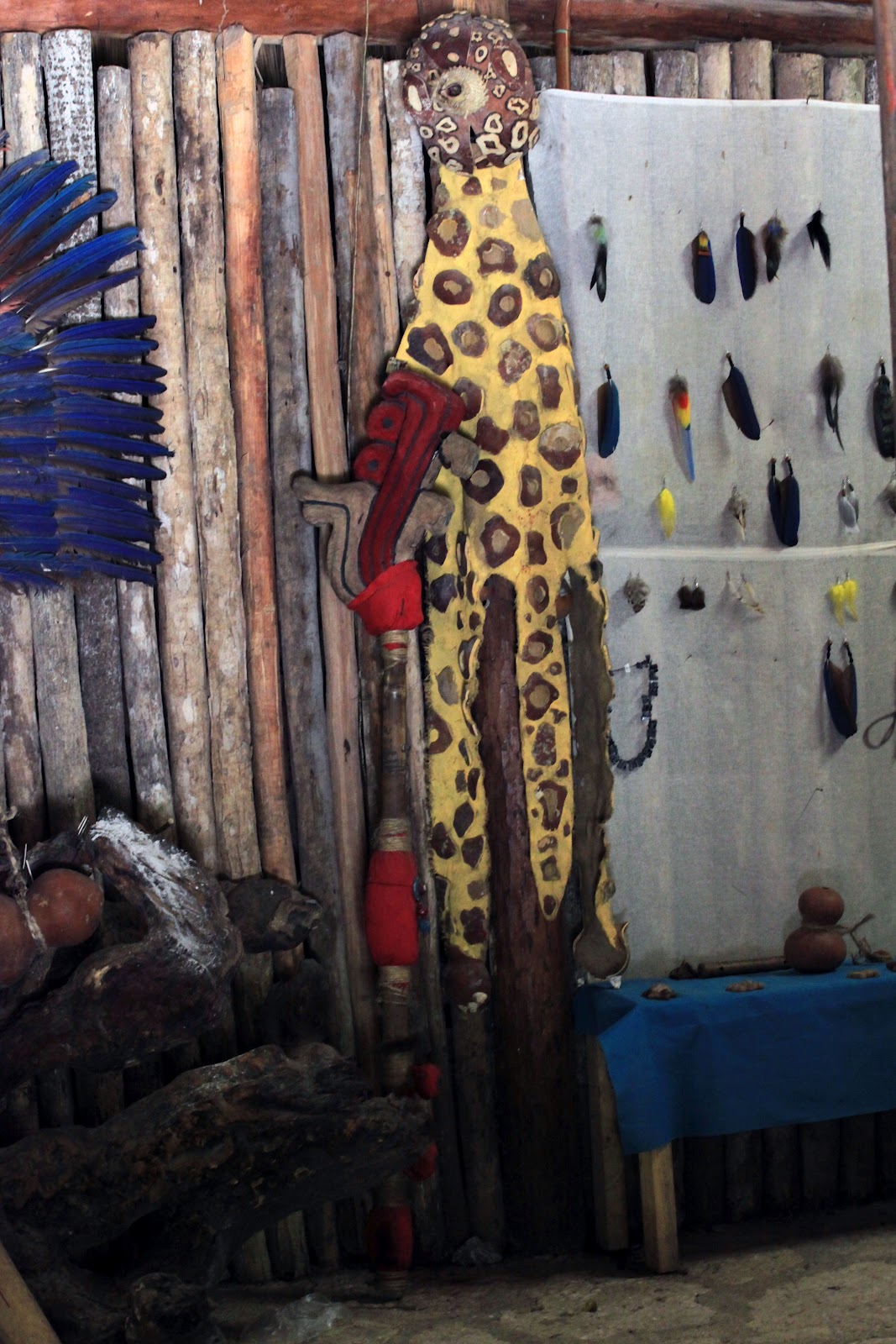
          I wander inside the shop, which is full of ritual items: headdresses, shields, drums, censors, costumes. I long to ask him about each fascinating object, but he speaks mostly Maya and my Spanish is very limited. So I content myself with admiring the wealth of native culture, which vibrantly alive on in this modern age.


Sunday, April 8, 2012

with the finest brush


with the finest brush
Oswaldo paints the Maya lord
of the wheel of time

At the Maya Village in Xcaret, a big Yucatan theme park, I watch Oswaldo applying brilliant color to a square of soft leather with the finest of brushes, the same type of brush I use for miniature gouache paintings. His attention is totally focused on making careful, tiny strokes, undisturbed by all the activity around him. His wife, Ascuncion, wearing a traditional white dress with floral embroidery, stands protectively behind him.
          The painting Oswaldo is working on depicts the Haab', the solar Maya calendar of 365 days, divided into 18 counts of 20 days with a count of 5 days at the end, which were considered unlucky days. This solar wheel shows the Maya lord of time at the center, supporting the burden of time on his back, represented by a glyph called ajaw, the name of the 20th day in the Tzolk'in calendar, and surrounded by the hieroglyphs for the 19 counts.
          The names of the 19 counts reflect aspects of the seasons of the solar year: mat, black conjunction, red conjunction, bat, watering time, dog, new sun, water, black storm, green storm, white storm, red storm, enclosed, yellow sun, owl, planting time, turtle, granary, resting of the year. However, because the Haab' does not take into account the extra quarter of a day in each solar year, the correspondence to the seasons would wander over the years.
          The Maya calendar is actually a system of calendars. The Calendar Round of 52 solar years includes the Haab' year of 365 days and the Tzolk'in, or Sacred Round, composed of 13 counts of 20 days, with each day having a unique name. For longer time periods, the Maya use the Long Count, which covers any length of time, past or future.
          This year the Maya calendar is getting a lot of attention everywhere because the Long Count of 20 b'ak'tuns, 7,885 solar years, will end on 21 December 2012. But rather than indicating a cataclysm, this is simply the day that the calendar will go to the next b'ak'tun at Long Count 13.0.0.0.0. 
          The cyclical nature of time was important to the Maya, who believed that each cycle had a particular character, which would influence events within that cycle, and the completion of one cycle and the recurrence of the next cycle was marked with ceremonies. So it will be interesting to see what influence the new Long Count of 20 b'ak'tuns will bring to the Earth and its inhabitants.
          I have a feeling that Oswaldo will celebrate on 21 December, and then return to his own cycle of painting.