Showing posts with label kamben. Show all posts

Thursday, December 8, 2011

at the soccer field


at the soccer field
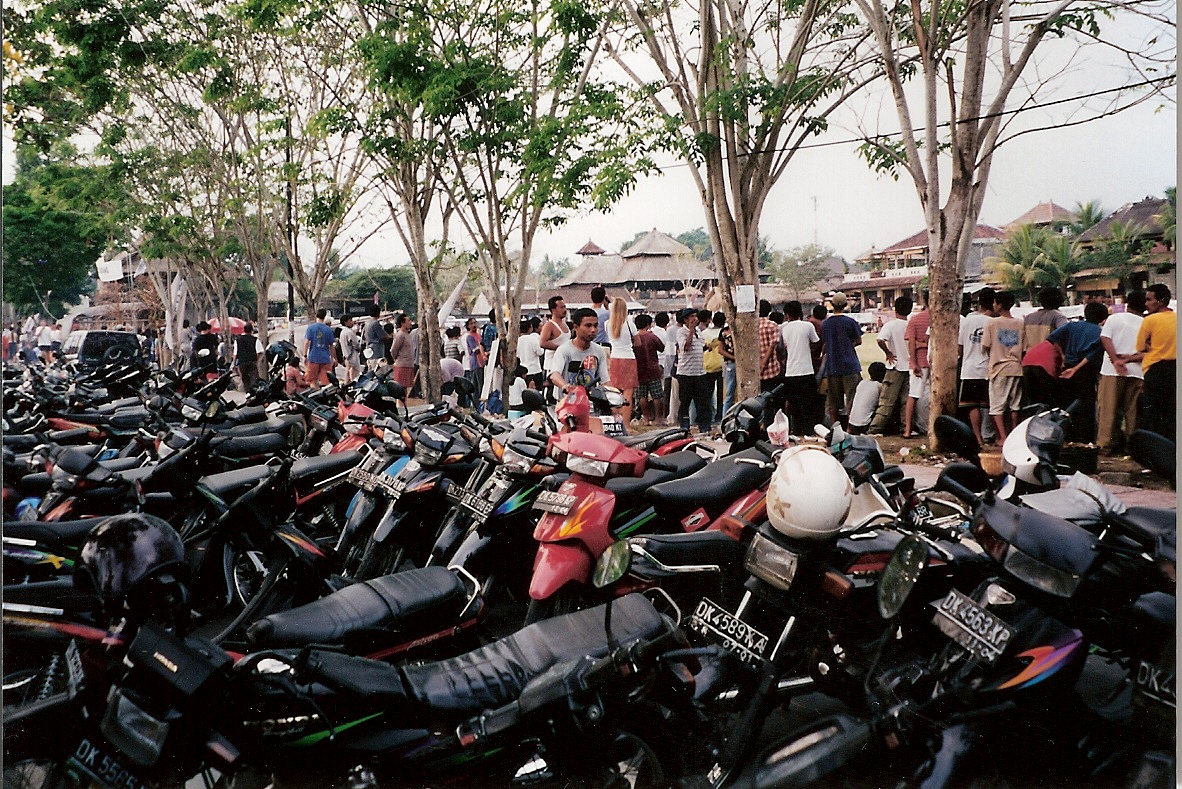
a sea of motorcycles,
a fence of people


On the way back from Ubud, we pass Astina Soccer Field on the other side of the road from a row of shops, restaurants, hair salons and massage parlors. A soccer game is going on, but all we can see is a sea of black motorcycles and a fence of people, mostly men. When the game ends, Robin says there will be a traffic jam from here to Denpasar. I'm glad we're walking and will be home before the mass exodus.
          Motorcycles are everywhere in Bali, by far the most popular means of transportation. I frequently see an entire family on one motorcycle, the father in front with a child on his lap, the mother behind, riding side saddle, not holding onto the father, but holding another child in her lap. Young boys who look like they're in grade school zip around on motorcycles and by middle school they have their own. Motorcycles are used for carrying everything, from bushels to bags, poles to pigs. 
          Public transportation is very limited on this small island, so motorcycles are the best way to get around. Robin is constantly hitching a ride on her various errands and appointments. Any time she's called on for a birthing, someone picks her up on a motorcycle. One day when Robin and I were coming back from a visit with Mangku Liyer, two women on motorcycles offered us a ride back to Nyuh Kuning. The women were both wearing jeans but we were wearing kamben, the traditional wrap-around skirt, so there was no way to straddle the seat. The woman told me to hold onto her waist, but I still felt insecure, perched sideways with no helmet. We made it home safely but next time I'll wear pants under my kamben!

Sunday, August 14, 2011

flourishing batik


flourishing batik,
flying dragons, leaping dolphins,
fluttering butterflies

Ubud is full little shops selling batik kamben, rectangles of cloth long enough to wrap around the waist twice and tie. A lot of this cloth (which tourists erroneously call sarong, a Malay word for a sewn tube of cloth) is designed for the tourist trade, printed in modern designs with vibrant colors. Today Robin takes us to a wholesale batik store, owned by a family whose baby she caught. We tour the shop where the cloth is dyed using the wax resist technique. In the showroom our group of ladies goes on a buying frenzy, pulling piece after piece from the stacks on shelves and flourishing them like banners. There are dragons, dragonflies, butterflies, dolphins, turtles, lotuses, sunflowers, suns and moons. We are given a special discount because of Ibu Robin, so of course we spend even more. Contemporary batik is quite different from traditional batik. Contemporary batik is often printed on rayon using stencils and aniline dyes. Traditional batik is made on cotton with natural dye colors, typically indigo, brown and yellow, representing the major Hindu deities, Brahmā, Vishnu and Śiva. The traditional method of batik making is called batik tulis. A design is traced onto the white fabric, which is stretched on a frame. Lines are drawn with a tjanting, a tool with a wooden handle and a tiny spouted metal cup for applying klowong, melted wax. The cloth is dyed to get the first color. After the cloth dries, some of the wax is scraped off with a knife and dyed again for the second color, and so on for each color. The cloth is hung in the sun to dry, then dipped in hot water to remove all the wax and dried again. Batik is used in many ceremonies in the Balinese life cycle, including the tedak siten ceremony when a child's feet touch the earth for the first time, special gold batik prada for temple dances, and as a shroud for the deceased.

Tuesday, August 9, 2011

early every morning


early every morning
offering rice, flowers, incense
to all the gods


A priest and priestess couple are the head of the family compound where we're staying. They both look serene and happy. Everyone here places small banana leaf offerings of cooked rice, flowers and incense all around the compound every morning, at the entrance, at each shrine and statue, and in every room. They hire a girl who makes all these offerings. The shop owners also make offerings, even the high-class ones. Climb a curved staircase and find an offering at the top. The priestess is wearing traditional adat dress for making offerings or going to the temple: a kamben, a wrap-around rectangle of cloth, usually in an indigo batik print, tied on the left-hand side; a kebaya, a lacy long-sleeved top; and a sabuk, a sash worn over the kebaya. Until the 1930s Balinese women went to the temple wearing nothing on top, but the Dutch convinced them to cover up. So now they wear lacy, nearly transparent tops with a little corset, quite alluring.