Showing posts with label pond ice. Show all posts

Thursday, February 19, 2015

below the fractal


below the fractal
pond ice a fallen shagbark 
hickory leaf suspended

February is often the coldest month of the year in these parts. Temperatures plummeted last night to below 0 F (-20 C). The ice on Jack's Pond across the road has frozen and thawed and frozen again in fractal patterns. The convoluted ice ridges hold a skiff of snow like etched frosted glass. 
          Just below the surface, a shagbark hickory leaf is held in suspension, its three lobes spread out like an airplane. During the last thaw the dark brown leaf drew more heat from the sun, melting and smoothing the ice surrounding it, creating a dark halo around the dead leaf.
          The first year we lived here, the pond froze overnight, the ice as smooth and transparent as glass. The black water beneath it looked like the night sky without stars. We walked on the frozen water. 
          Just below the surface, we saw something huge and dark -- a snapping turtle, its shell as long as my arm and nearly as wide. We stopped and stood above the turtle, separated only by a shield of ice. Was it dead? 
          But no, the turtle was moving its legs, swimming ever so slowly. How could it breathe, with ice sealing off the air? The turtle held its pointy snout upright like a snorkel, so perhaps it was breathing a thin layer of air trapped under the ice. 
          This common snapping turtle could live for a hundred years. It's got that thick shell for protection and a powerful beak for snapping both prey and predators, and it's obviously able to survive in frigid ponds without hibernating. 
          Years have passed, but I still see that turtle, suspended below the ice -- moving, alive.

Sunday, March 4, 2012

melt holes on Jack's Pond


melt holes on Jack's Pond
fuzzy around the edges
where snow meets ice

We're getting more snow in March than we have all winter. Snowfall all day and into the night, changing from slanting clumps to floating feather flakes to tiny pellets. It's a world of black and white. The ice holes on Jack's Pond look like fuzzy black caterpillars. A diorama of white mastodons curves along the black wire holding the bamboo fence together. A snow serpent undulates along the top of the steel bike rack. And white icing lines the fractal limbs of a Black Locust.

Wednesday, February 15, 2012

grey ice on the pond


grey ice on the pond
still firm enough for two dogs
to take a shortcut

Light rain all day, dissolving the remnants of snow, softening the ice on the ponds. Coming home, I'm surprised to see two black and white farm dogs out for a jaunt across Osage Pond, taking a shortcut from the barn to the road. 
          Reminds me of the time in my youth when I walked all the way across Lake Harriet, a lake in the middle of Minneapolis, Minnesota. We lived right by the lake and I'd walked or biked around it many times, swam and even ice skated along the edge. I'd seen ice boats and ice fishermen out on the frozen lake and one day I decided to see what it was like out there. Of course, it was foolish to venture that far out all alone.
          In the middle of the lake, the wind had swept the snow off the ice, which gleamed like obsidian. When I got to the other side, my face was so windburned that I decided to walk the long way around to get back home. 
          Later that day my father remarked that the lake must be melting because you could see open water out in the middle. I started to say, no, that's just bare ice, but I didn't dare let him know how I knew. That's one of the few times I've ever done anything really risky, and it gave me just a tiny glimpse of what it feels like to be a daredevil.

Friday, December 9, 2011

snow halos on blue


snow halos on blue
ice surround splintering
spokes from black holes

A layer of fresh snow on the blue ice of the pond forms granular white halos around open water holes sending forth fractal branches. One of the patterns looks like a crystal dendrite, another could be a caricature of the DaVinci man with arms and legs inscribing a circle, others appear to be flying dinosaurs. On a nearby bank, a living bird has left its signature in the snow, wings feathers outspread, like the snow angels we made as children. I wonder what would inspire a bird to spread its wings in white ice crystals?

Wednesday, March 9, 2011

cold rain -- on Jack's Pond


cold rain – on Jack's Pond
ice melting in dark blotches,
spines, tendrils and tails

Cold, late winter rain, after threatening for days. Jack’s Pond is still covered with ice, melting in strange patterns. One looks like a Cyclops from space or a neuron from a human brain, complete with projecting dendrites, cell nucleus and the tail-like axon.

Wednesday, February 23, 2011

black ice on the pond


black ice on the pond –
wild geese swim in a circle
of open water

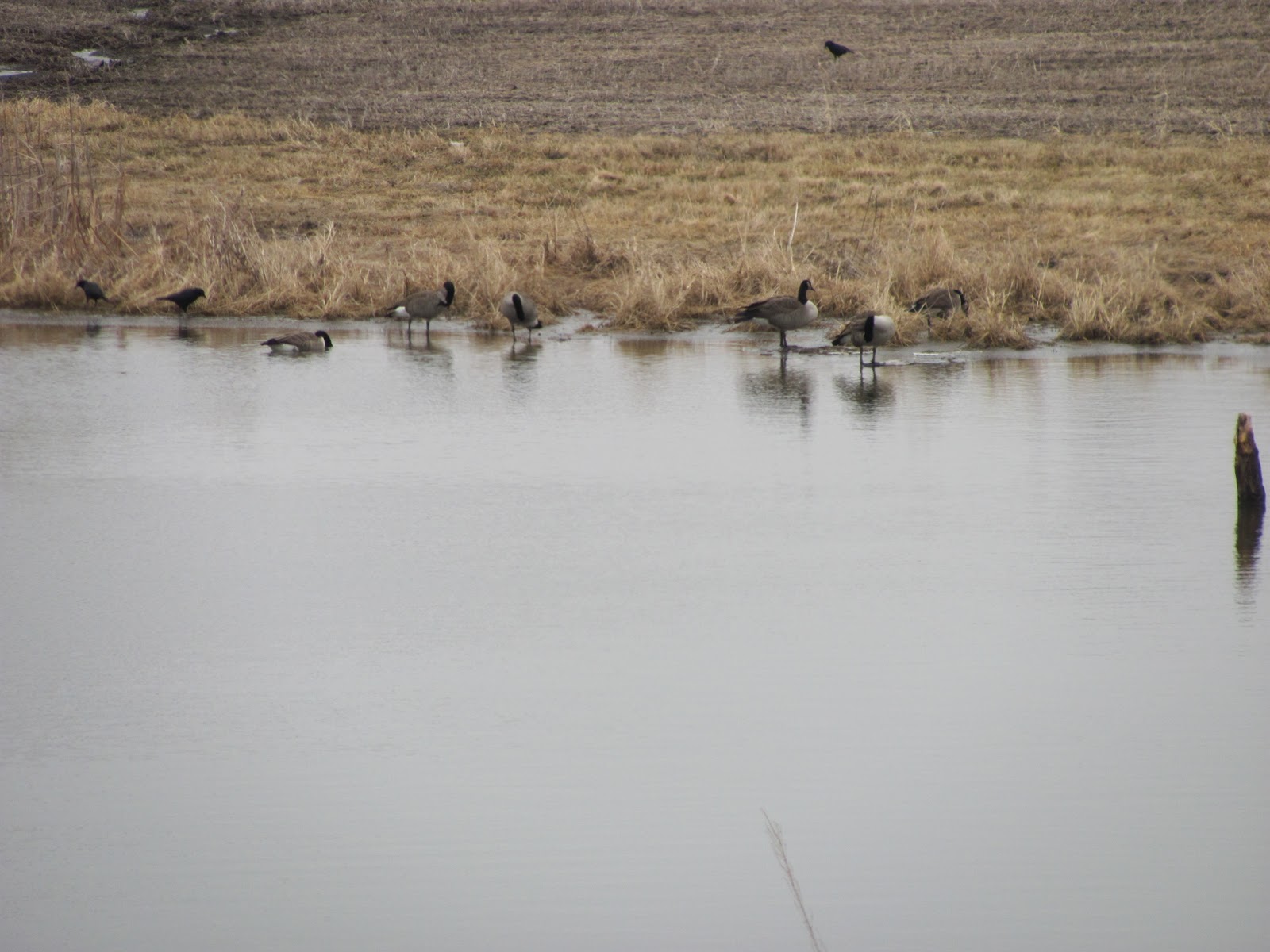
A freeze last night laid down a skin of thin, black ice. The thin ice forms vertical crystals that reflect less light, making it appear black. The Canada geese have not moved on. This morning they are swimming in a circle of water kept open by their swimming. In the afternoon it rains, the thin ice melts and the geese are joined on the shore by a few scavenging crows.

Saturday, February 19, 2011

islands of snow foam


islands of snow foam,
scalloped, peaked, pocked – pond ice pitted,
fissured, floating free

The snow has retreated into islands on shaded hills and in culverts. Some patches look like platters of whipped cream, covered with peaks and depressions. Others look like the mirror image of altocumulus clouds, puffy and scalloped. The ice on the pond is dull and grey, fractured and full of small holes with radiating cracks. Around the perimeter the ice has shrunk back from the banks, leaving a narrow rim of open water, so that the entire sheet of ice has become an ice floe. It looks like the map of an unexplored island, with lakes and streams and tributaries of rivers running down to the sea.