Monday, February 13, 2012

black horse in the snow


black horse in the snow
eating dry grass from my hand --
where are you going?

Ever since the two young bulls disappeared, the little black horse has been staying close to the little red barn. On a snowy day I stop to see how she's faring. Her nose is buried in freshly fallen snow, seeking tender grass among the brittle weeds. Her black coat stands out against the whiteness. When she sees me approach, she looks up and walks towards me, which surprises me. When she kept company with the bulls, they usually moved away when I appeared. 
          Now she stops and surveys me for a moment. I'm wearing a furry brown hat, brown coat, brown gloves, brown boots, and the black camera I'm holding up to my face might look like a black nose. Perhaps she thinks I'm one of her lost companions. But maybe I'm not giving her enough credit for knowing the difference between a four-legged and a two-legged animal. In any case, she pushes on through the snow to the fence where I'm standing. 
          Her mane is still matted with burrs and her back is a little wet from the snow, but her thick coat must keep her warm. She sticks her head over the low fence and I scratch behind her ears. She nuzzles my hand. What, no apples? Tangerine, yuck! She pushes my hand away, so I pull some long grass and feed it to her. Some of it gets caught in her mane and some of it drops on the ground, but she manages to swallow a little of my offering. The grass on this side of the fence is about as scarce as on her side, so I quickly run out. While she's rummaging around on the ground for the bits she dropped, I start to walk away. She looks up, a stalk of grass dangling from her mouth. What, you're leaving? Where are you going? Are you coming back?
          Maybe I'm reading too much into those pleading eyes, but I feel sad leaving her alone again. Horses do form lasting friendships, usually with other horses, but in her case I believe she misses those two brown bulls. Next time, I tell her, I'll bring apples.

Sunday, February 12, 2012

undulating swash


undulating swash 
and backswash of wavelets mold
sinuous sand tracks

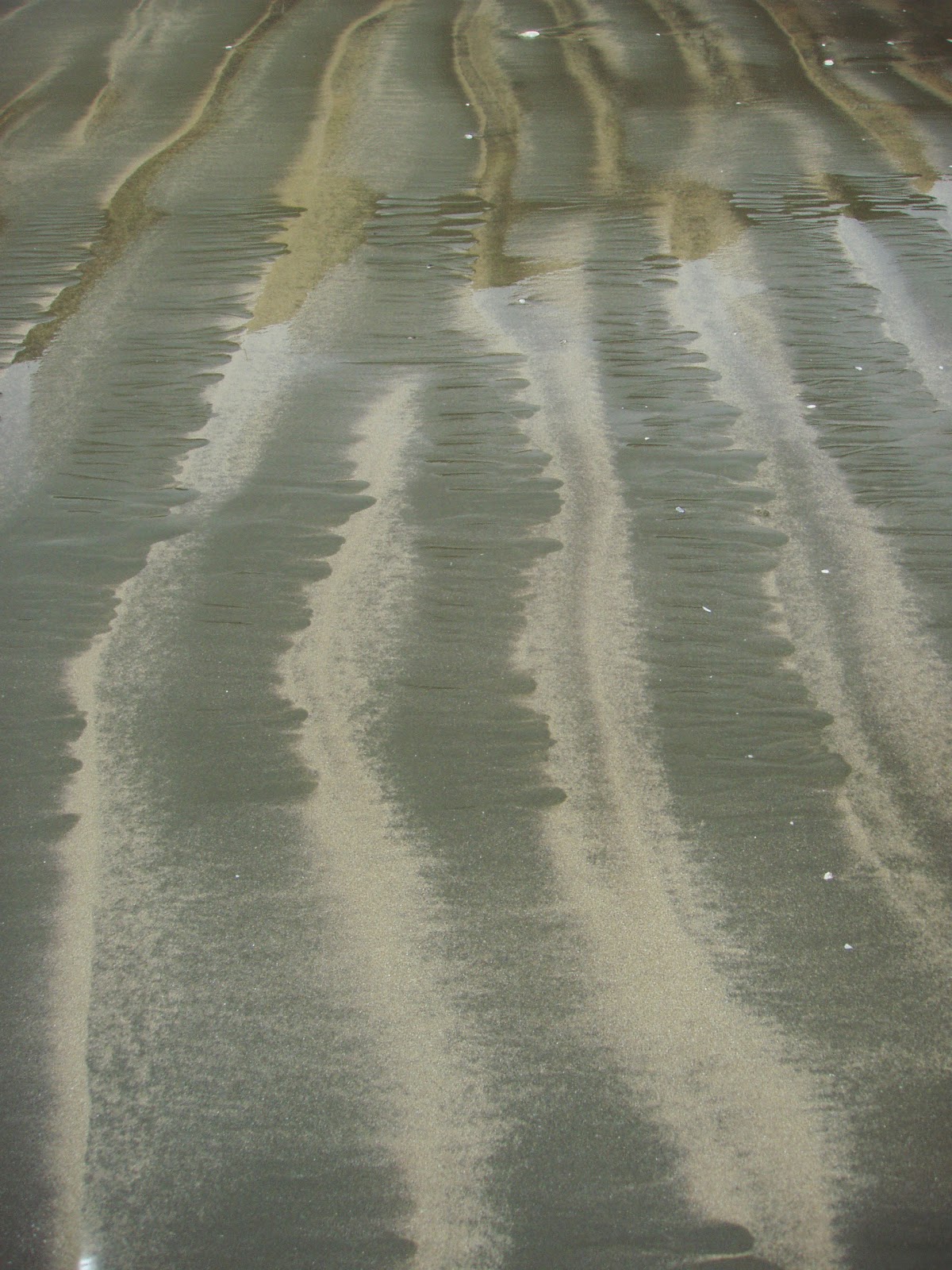
After a sumptuous breakfast at the inn near Akaroa, I walk down the country road to a little beach. The tide has recently receded, leaving the silver sand glistening with sinuous patterns. The swash and backswash of tiny wavelets breaking and receding have molded the fine sand into undulating tracks. It looks like hundreds of fingertips have pushed thick paint into wave-like crests, leaving their still-wet imprints. This tenuous finger painting will be erased when the Sun and Moon pull the waves back to cover the shore, only to be recreated at the next low tide.

Saturday, February 11, 2012

girl with Siamese cat


girl with Siamese cat
posing for a Polaroid,
enigmatic smile


In 1972 we sold the Nikon totally manual SLR to buy the original Polaroid SX-70, the first instant SLR and the first camera to use the new integral print film. It was an elegant camera, with its body finished in brushed chrome and genuine leather panels, and so slim folded up that it fit in a pocket or purse. A magical camera. Take a photo, out pops an embryonic print and it develops automatically right before your eyes in broad daylight. Everything required for development -- negative, developer, fixer -- was contained in the integral film. No more toiling in our darkroom, no more sending film out to be developed. But if you still want to get your hands, literally, in the development process, you can push the emulsion material around during the several minutes before it sets, creating results like impressionistic paintings.
          When Edwin H. Land, founder of Polaroid, announced his revolutionary instant sepia film to the world, he said, "The purpose of inventing instant photography was essentially aesthetic -- to make available a new medium of expression to numerous individuals who have an artistic interest in the world around them."
          Certainly that was our experience as we experimented with our Polaroid SX-70. Even the unmanipulated photos came out looking like a Rembrandt painting, with lots of chiaroscuro, like this portrait of me with our Siamese cat, Suji. There's only problem with this early film that turns into a print -- over the years the finish begins to crackle. So I've been slowly going through old albums, scanning them into digital files and restoring them in Photoshop.
          Polaroid was also one of the early producers of digital cameras, beginning with the PDC-2000 in 1996, but they weren't able to compete in that market. In October 2001, the company filed for bankruptcy. Bank One bought their assets and formed a new company that continued to produce Polaroid cameras. Sadly for Polaroid lovers, they stopped manufacturing the cameras in 2007 and stopped selling the film in 2009. 
          Fortunately, in 2010 the film became available again through The Impossible Project, a company with a name as magical as its products. A month ago, in January 2012, they announced the launching of The Polaroid Classic range, collectible products from different periods of Polaroid's history, with six to ten products to be released each year. Now we can celebrate the resurrection of an amazing artistic medium.

Friday, February 10, 2012

moon caught in a web


moon caught in a web
of black limbs, snow moon, hunger moon,
opening buds moon


Native American tribes of the north and east often called February's full Moon the Full Snow Moon, since the heaviest snow usually falls during this month. Hunting was difficult in such harsh weather, so some tribes also called this Moon the Full Hunger Moon. Paradoxically, if the weather was mild, the warmth would induce trees to bud, giving the full Moon the name Opening Buds Moon.
          We have had almost no snow this winter and not a long cold spell. But today the wind is blowing strong from the northwest, making it feel much colder than the reading on the thermometer. The full Moon, rising through a web of bare black limbs, looks like a baseball I found in the woods, its white leather cover rotted away, revealing yards of string wrapped around the hard core.

Thursday, February 9, 2012

wings of Pegasus


wings of Pegasus --
peaked white earth domes perched
on the side of a green hill

The white domes at the hostel for Pegasus School are constructed from earth-filled bags coiled like a straw bee skep and then plastered with earth. They look like Hobbit huts perched on a green hill outside Kathmandu. When Pam and I visited two years ago, the inside walls and the domed ceiling of the kitchen were black with soot from gas cooking fires, but that only added a natural patina, while the potato storage room was painted blushing pink.
          We arrived at the start of a Maoist general strike which shut down everything -- government, schools, businesses, banks, street vendors, and traffic, except for emergency vehicles -- and there were rolling blackouts. It was too dangerous to walk in some areas, so we had to wait to visit the two schools where Shanti Children's Foundation, founded by Pam, sponsors a number of needy children. It was a joyful moment when I finally met Thrinley, the girl we've been sponsoring for 12 years. 
          Now we hear from Kinley Lama, the Director of Pegasus, that things are "the same or getting a bit worse. Power cuts have reached 14 to 16 hours a day, but the good thing is that we know in advance when we will be having the cuts so we can prepare. Fuel prices have gone up by 10 to 20 % and even with the high increase in prices fuel is not available. Which makes us all wonder, what is happening to this country?"
          He goes on to say that "the biggest problem is cooking fuel, kerosene as well as cooking gas. Both are not available anymore and the weird thing is that the government or people responsible for these are not doing anything. Cooking for the children is now being done by firewood. We buy it from the local villagers. The staff use cooking gas but everyone seems to have only enough stock for maybe a week. Then it looks like we have to go back to using firewood too. At least for us we have the option of using firewood, but I am wondering what is happening with the people living in the urban areas?"
          And I am wondering what happens when they can no longer get fuel for the bus that takes the boarding students from the hostel to town every school day? During the Maoist strike, when they could not get to the school in town, they had classes at the hostel, all of the students in one big room, seated from oldest to youngest.
         The good news is that the children are all fine and two more girls will be joining the hostel on Friday, an auspicious day for them. "Thank you very much for that," Kinley writes. "I think we most probably saved the older one from being a domestic helper for life." He also thanks Pam for her hard work and support in finding sponsors. "I know that it is very hard for most people in the US also with the financial crunch."
          Perhaps harder for some than others, although we still have electricity and fuel, so far. But I'm glad that we have a wood stove, a wind turbine and solar panels!

Wednesday, February 8, 2012

polka dot pond ice


polka dot pond ice,
fractured crystal spears on the creek,
leaf melt shadow

February's rhythm, freeze/thaw, beats out jazzy crystal patterns on the creek, paints abstract black and white art on the ponds. Bubbles from the depths of Jack's Pond melt dark circles in the snow-covered ice. The warmth of a dark leaf melts its outline in the ice. On Pilgrim Creek, a frozen crystal wave hovers above reflections of trees and rippled mud. A shield of fractured ice, undercut by the current, rests on a tree trunk.  

Tuesday, February 7, 2012

molten rock frozen


molten rock frozen
in black waves -- water frozen
in crystal white foam

There's a whole Noh performance going on in this slab of black lava, masked singers chanting in a drone and dancing in highly stylized slow movements. Perhaps it is Shakkyo, Stone Bridge, or Shojo, the Tippling Elf, or Kumasaka, the Robber. Even the snow looks like a grimacing mask, melting to reveal the masked black demons. The transience of the snow contrasts with the ancient frozen flow of lava, yet even the adamant stone slowly yields to the softer elements of water and wind.