Showing posts with label photography. Show all posts

Tuesday, November 12, 2013

red and all red


red and all red
stairs not going anywhere
only the people

Behind a white door, a red staircase connects lower and upper floors in an old building on the town square. The staircase stays put, not going anywhere, but hundreds of feet over the years have gone up and down, down and up, wearing the risers swayback. 


This must have been a dark passageway when it was Gobbles Clothiers, a men's clothing store owned by fourth generation Iowan, Lee Gobble, for 50 years. You can still see the old bricks peeking from behind the thick plaster.


Now the building houses ICON Art Gallery, and in the hands of artist Bill Teeple the dark stairway has been transformed into a study in color, light and texture.


A place of magic where the way up is also the way down, or neither up nor down, but a place halfway to everywhere and everywhen. It's easy to get there. Just lie upside down on the crenelated steps, stare at the stairs and dream red and all red dreams.

Wednesday, May 16, 2012

weaving strands of light


weaving strands of light
into golden nets, rainbow 
glyphs, luminous wings

For this session on photographing in low light, we set up our cameras on tripods and adjust our settings. Now the fun begins. Light sticks and light cords create dramatic effects unseen by the eye, which appear like magic in the digital images.

Saturday, February 11, 2012

girl with Siamese cat


girl with Siamese cat
posing for a Polaroid,
enigmatic smile


In 1972 we sold the Nikon totally manual SLR to buy the original Polaroid SX-70, the first instant SLR and the first camera to use the new integral print film. It was an elegant camera, with its body finished in brushed chrome and genuine leather panels, and so slim folded up that it fit in a pocket or purse. A magical camera. Take a photo, out pops an embryonic print and it develops automatically right before your eyes in broad daylight. Everything required for development -- negative, developer, fixer -- was contained in the integral film. No more toiling in our darkroom, no more sending film out to be developed. But if you still want to get your hands, literally, in the development process, you can push the emulsion material around during the several minutes before it sets, creating results like impressionistic paintings.
          When Edwin H. Land, founder of Polaroid, announced his revolutionary instant sepia film to the world, he said, "The purpose of inventing instant photography was essentially aesthetic -- to make available a new medium of expression to numerous individuals who have an artistic interest in the world around them."
          Certainly that was our experience as we experimented with our Polaroid SX-70. Even the unmanipulated photos came out looking like a Rembrandt painting, with lots of chiaroscuro, like this portrait of me with our Siamese cat, Suji. There's only problem with this early film that turns into a print -- over the years the finish begins to crackle. So I've been slowly going through old albums, scanning them into digital files and restoring them in Photoshop.
          Polaroid was also one of the early producers of digital cameras, beginning with the PDC-2000 in 1996, but they weren't able to compete in that market. In October 2001, the company filed for bankruptcy. Bank One bought their assets and formed a new company that continued to produce Polaroid cameras. Sadly for Polaroid lovers, they stopped manufacturing the cameras in 2007 and stopped selling the film in 2009. 
          Fortunately, in 2010 the film became available again through The Impossible Project, a company with a name as magical as its products. A month ago, in January 2012, they announced the launching of The Polaroid Classic range, collectible products from different periods of Polaroid's history, with six to ten products to be released each year. Now we can celebrate the resurrection of an amazing artistic medium.

Monday, February 6, 2012

flame and reflection


flame and reflection
of flame -- a pillar burning
without and within


Reflection on reflections. A reflection is a flip over a line. This virtual line is called the Mirror Line. It divides the "real" object from its reflected image. Every point in the object and its reflection is the same distance from the Mirror Line line and the reflection has the same size as the original object. In this reflection, we see two candles, one burning on the window sill and the other burning inside the frame of a photograph, lighting up the image of a pear in the center of a coil of rope. The photograph, of course, is an image of an object. And the photograph of the photograph is an image of an image.

Monday, September 19, 2011

inside the black box


inside the black box
a woman gazes through books
reflected in glass

My mother met my father when they both worked for their college yearbook. They got married in 1939 and started having kids in 1942. We have lots of black and white pictures of us from those early childhood years, which may have been taken with a Kodak camera like this one.
The Kodak Vigilant Junior Six-20 was a folding camera made in the USA and Canada by Eastman Kodak Company from 1940 to 1948. It took 6x9cm images on 620 roll film. It has a folding frame finder incorporated into its top housing and another optical finder near the shutter. It was similar to the Kodak Vigilant Six-20, but with a simpler lens and shutter. There was also a larger model, the Vigilant Junior Six-16. The camera was equipped with a simple fixed focus, single speed Kodet meniscus lens (approximately 1/100 sec, plus B- and T-settings) in a Dak shutter with f-stops from f/12.5, f/16, f/22 and f/32. It was also made with a better three-element Bimat lens in a Dakon shutter.
My first camera did not look like this cool Kodak. It was a Roy Rogers and Trigger snap shot box camera, made in 1950 by the Herbert George Company of Chicago. The camera used 620 film. It did not have the nifty bellows, but I loved it because Roy Rogers was my hero. He sent me a photo of himself when I was in the hospital in 1948 for third degree burns. This happened when my cowgirl outfit caught on fire while my older sister and I were playing "campfire" near a trash incinerator. The autograph said, "Always be good for Roy Rogers."

Monday, May 16, 2011

temple of the sun

 
temple of the sun
resonates with the golden
flute of the traveler

Paul Horn, known as the Traveler, played his flute in the Temple of the Sun at Machu Picchu. He has also played in many sacred spaces around the world, including the Taj Mahal, the Grand Canyon, the Potala and Mt. Kailash in Tibet, the Great Pyramid at Giza, and with orca whales. It was "Inside" his recording in the Taj Mahal in 1968 that launched the genre of New Age music. Paul was with Maharishi Mahesh Yogi in Rishikesh, India, in 1967, at the same time as the Beatles and Donovan, and he became one of Maharishi's first teachers of Transcendental Meditation. This year Paul played in the Golden Dome on the campus of Maharishi University in Fairfield, Iowa. His soulful melodies on a golden flute reverberated in the atmosphere of deep, lively silence that permeates the Golden Dome.

Tuesday, May 10, 2011

high on a white wall


high on a white wall
a small window filled with bundles
blocking the view

Windows are usually designed to let light in and allow those inside to see out, though not always those outside to see in. This small window placed high on a white adobe wall seems designed to allow a view of the main street of the pueblo, while disallowing a view inside. However, the pile of bundles would make it difficult for anyone to see out. The entire place feels unusually empty and quiet for an Andean pueblo: no mototaxis, no triciclos, no people, no dogs, not even chickens roaming the street. Perhaps everyone is taking a siesta, or out working in the fields and pastures. Later, we do see two women and then a group of children coming home from school. But even then, silence prevails. Perhaps it is the influence of the temple of the moon on the mountain above the pueblo, a place of deep solitude and silence.

Sunday, May 8, 2011

moon temple pueblo


moon temple pueblo –
white crescents cascading down
adobe brick wall

The temple of the moon, on a hill beneath a mountain, is a magical place, and even the little pueblo at the foot of the hill is full of mystery, like this adobe wall beneath a tile roof. Someone has painted some words on the brick wall and over the words, a series of overlapping white crescents, the paint dripping down and nearly obscuring the letters. I can make out "Altalde" below the crescents, but not the letters above. Is this a political slogan? The presidential election is about to take place and the names of candidates and parties are painted on walls everywhere. But if this is a name, did someone purposefully cover it up? The white paint looks like crescent moons, and the temple of the moon on the hillside above is dedicated to the mysterious, changeable feminine aspect. The roof tiles repeat the feminine curves of the crescents. The entire wall looks like an abstract painting, an act of creativity, intensely feminine.

Saturday, May 7, 2011

between the train tracks


between the train tracks
and hot springs a young mother
nurses her baby

Beyond bearing a baby, the most intimate act of motherhood is nursing. This young mother is sitting outside her little shop on the steep street that leads from the train tracks to the hot springs in Aguas Calientes, quietly feeding her infant, completely at ease while all sorts of people pass by.

mama with bebe


mama with bebe
wrapped in a red k'eperina
snug against her heart

This mother and baby are standing in the pedestrian street outside the school with its colorful murals. She is carrying her baby in a k'eperina, Quechua for a handwoven rectangular cloth used for carrying children and other goods. Often red, with intricate striped designs, it is used by both men and women, even by those who wear modern dress, like this young mother in jeans and a sweater. The baby wears a hand knit chullo on his head. This first cap is traditionally knit by his father and the color white indicates that the baby is a boy.

Friday, May 6, 2011

blue door, yellow wall


blue door, yellow wall –
reflections of sky and sun 
transform wood and clay

We are on the bus, leaving Cusco for our destination in the Sacred Valley. Fascinated by the colors and textures of the buildings, I keep up a steady barrage of snapshots, hoping to capture a small fragment of the passing scenery. I am always amazed by a lucky catch like this one. The bright blue paint on the worn wooden door and the ocher plaster on the adobe wall bring the essence of the Andean sky and sun down to earth. So it is with earth-bound humans, always reaching for what lies beyond.

Thursday, May 5, 2011

life's little hurdles


life's little hurdles –
climbing over a fence to chase
a pig in the mud

After the bus got stuck in the mud high on the hill, we walked down to the highway to wait for another bus to pick us up. A little pueblo is stretched out on the lower part of the hill. It starts to rain so we take shelter under an overhanging roof. While I am looking over the adobe wall next door at all the laundry getting wet, I spot a black pig trotting under the clothes line. Then a woman climbs over a low fence and chases the pig through the muddy yard. Life in a pueblo is lived out in the open and close to the earth, sometimes literally in the mud.

Monday, May 2, 2011

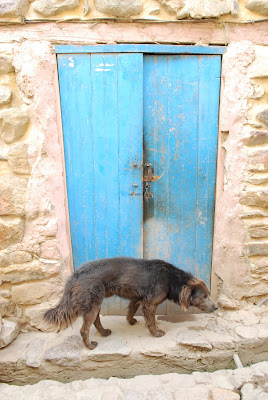
latch on a blue door


latch on a blue door
on a stone house on a stone street –
dog waiting outside

Portals fascinate me, that gap between outside and inside, here and there, open or closed, allowing in or keeping out or passing through The latch on this door in Ollantaytambo has obviously been used a lot, from the circular mark worn through the blue paint, but there is no lock on the latch and the door is slightly ajar. Anyone might enter, or exit, at any moment. The dog, standing outside, head down, does not seem to be guarding the door but rather to be patiently waiting for someone to appear.

Thursday, April 28, 2011

an earthenware bowl


an earthenware bowl
of sopa de kinwa y choclo
with mate de coca

Peruvians have a genuine ethnic cuisine based on many indigenous ingredients. Everything has a distinct, delicious flavor. Maybe it's the soil combined with organic farming. The midday meal begins with sopa, followed by salada, then the main course and dessert. At this restaurant in Pisaq, the soup is made with kinwa and choclo, and we can choose mate de coca or fresh lemonade. Kinwa (quinoa), choclo (a type of maize), and coca were all considered sacred by the Inkas, who used them in their ceremonies, and they are still used in this manner by indigenous Andeans. The word kinwa means "moon" in Quechua, and the cooked seeds do look like little moons and crescents. The Inkas called it chisaya mama, "the mother of grains." The Inka emperor traditionally sowed the first seeds of the season using a gold implement. The Spanish conquistadors forbade the cultivation of quinoa due to its association with non-Christian ceremonies. Technically a seed, it has more protein than any grain. Gluten free, it is easy to digest and has a nutty flavor. Choclo has large pale yellow kernels. Very popular boiled on the cob, it also has a nutty flavor. Mate de coca is made from coca leaves. Indigenous people chew the leaves as a stimulant, forming a wad in the cheek. Everyone in Peru consumes it as a tea, which tastes like green tea, slightly bitter. It is held to be especially beneficial to health altitudes, so we drink a lot of mate de coca.

Tuesday, April 26, 2011

inside turquoise doors


inside turquoise doors 
a little boy peers out as
his brother runs to school

Traveling on yet another bus, tired but unwilling to take my eyes off the passing scenery, I keep glimpsing fleeting moments of beauty. I keep my camera turned on and raised to the window. Somewhere between Urubamba and Ollantaytambo, I spot a little boy in a blue school uniform and backpack leaping away from a pair of turquoise doors. When I look at the frozen moment on the view screen, I notice the other little boy peeping from behind the closed door, perhaps wistfully watching his older brother run off to school.

Thursday, March 3, 2011

moon over turquoise


moon over turquoise
Lake Pukaki – pink clouds
above Aoraki

From our tents on the shore of Lake Pukaki, we have a beautiful view of Aoraki and his two brother mountains through a gap in the hills. After sunset the clouds put on a moonlight sonata full of fans, curlicues and saucers. Lake Pukaki is the largest of three alpine lakes formed when receding glaciers blocked the valleys with terminal moraines. The lake is fed by the Tasman River, which has its source in the Tasman Glacier. Finely ground rock particles brought down by melt water from the glacier gives the lake its turquoise color