Showing posts with label Ollantaytambo. Show all posts

Thursday, June 23, 2011

red k'eperina


red k'eperina
on blue clothesline with brown hen
and blue triciclo

A typical adobe house along the road between Urubamba and Ollantaytambo in the Cusco region. The colorful striped k'eperina is worn around the shoulders and used for carrying all kinds of goods. The triciclo, with its little flatbed over the rear wheels, is also used for carrying all kinds of goods, like this blue bucket. The little brown hen, resting in the shade, is used for laying eggs. I like the way the door with its faded blue and red paint picks up the color theme, and even the clothesline matches the blue of the triciclo and bucket.

Sunday, June 19, 2011

altar of condor


altar of condor
feathers, bowls of choclo, bulls,
a vicugna skull

In a courtyard in Ollantaytambo, we happened upon this collection of what appear to be shelves full of revered objects. Three long condor feathers stand upright in a bowl of ground choclo, or maize. Choclo in its various forms, dried, ground and fermented into maize beer, are all used as ritual offerings. The large pottery vessel and teapot sitting on pottery stoves may be used for fermenting the aqhachicha. The condor is an important symbol in Inka mythology. The Inka perceive the world as having three levels: Hanan Pacha, the upper celestial world, contains the sun, moon, stars, rainbow and lightning; Uku Pacha, the inner earth, is the realm of Pachamama, the earth mother; Kay Pacha, the outer earth, is the realm of humans. These three realms are symbolized by the chakana, the three-stepped cross or world tree. The condor, snake and puma are the totemic representatives of these three realms. The bull is associated with strength. A pair of ceramic bulls are often placed on top of houses as guardians. The small skull may be that of a vicugna, or vicuña, as depicted in the pottery vessel next to it. Vicugna, a wild camelid related to the llama, is known for its extremely fine, warm wool. The small animal only produces about one pound of wool a year. During the time of the Inkas, vicugna fibres were gathered during a communal chacu, in which multitudes of people herded hundreds of thousands of the animals into funnel traps where they were sheared and then released. This was only done once every four years. The vicugna was believed to be the reincarnation of a beautiful young maiden who received a coat of pure gold once she consented to the advances of an old, ugly king. Because of this, it was against the law for anyone to kill a vicugna or wear its fleece, except for Inka royalty.

Saturday, June 18, 2011

golden Wiraqocha


golden Wiraqocha
mask on an adobe wall,
guardian of the house


The golden mask embedded in this adobe wall in Ollantaytambo is clearly some kind of guardian entity, possibly Wiraqocha, the great creator god in the pre-Inka and Inka mythology. Wiraqocha is seen as the creator of all things, or the substance from which all things are created. Wiraqocha created the universe, sun, moon, stars, time (by commanding the sun to move over the sky) and civilization itself. Wiraqocha is worshipped as god of the sun and of storms and is intimately associated with the sea. He is represented as wearing the sun for a crown, with thunderbolts in his hands, and tears descending from his eyes as rain.

Thursday, June 9, 2011

still life with white flowers


still life with white flowers,
crewelwork tapestry and
chulucanas vase


In an artisan's shop in Ollyantaytambo, we admire the collection of art. The pink and black wall hanging is a beautiful example of crewelwork, a type of free embroidery with wool yarn applied to wool cloth. The designs include abstract lines and a stylized condor with two Inkas in ceremonial dress on either side. The black and white vase is an exquisite example of the pottery made in Chulucanas, a pueblo on the north coast of Peru, by descendents of the Tallanes, pre-Columbian peoples. The pottery is created through a unique multi-step process. Several techniques are used in the forming. Then a base slip is applied and the piece is burnished three times with river stones. After drying, the piece is fired in a wood-fired kiln. Next, the piece is decorated in a reverse method in which slip is applied to the parts to be left intact. A resin is also applied to give the piece its characteristic brilliance. Several more firings in a smoke kiln with mango leaves darken the uncovered areas. Then the slip is removed and a final wax finish is applied. When completed, each item is signed by the artists who created it. Simple and stunning.

Monday, May 2, 2011

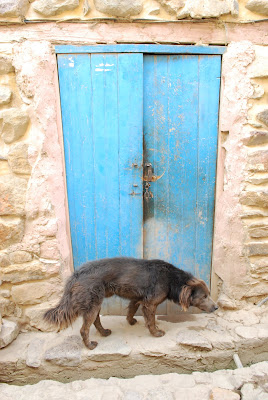
latch on a blue door


latch on a blue door
on a stone house on a stone street –
dog waiting outside

Portals fascinate me, that gap between outside and inside, here and there, open or closed, allowing in or keeping out or passing through The latch on this door in Ollantaytambo has obviously been used a lot, from the circular mark worn through the blue paint, but there is no lock on the latch and the door is slightly ajar. Anyone might enter, or exit, at any moment. The dog, standing outside, head down, does not seem to be guarding the door but rather to be patiently waiting for someone to appear.

Tuesday, April 26, 2011

inside turquoise doors


inside turquoise doors 
a little boy peers out as
his brother runs to school

Traveling on yet another bus, tired but unwilling to take my eyes off the passing scenery, I keep glimpsing fleeting moments of beauty. I keep my camera turned on and raised to the window. Somewhere between Urubamba and Ollantaytambo, I spot a little boy in a blue school uniform and backpack leaping away from a pair of turquoise doors. When I look at the frozen moment on the view screen, I notice the other little boy peeping from behind the closed door, perhaps wistfully watching his older brother run off to school.

Friday, April 22, 2011

the blind harpist plays


the blind harpist plays 
celestial music above
the noise of travelers

From the bus parking lot at Ollantaytambo, it's a long, gradual descent by foot to the train station to wait for the train to Aguas Calientes. Near the bottom of the hill the path makes a turn to the left and there is a little stall where an elderly woman is selling bottled water, dried corn and various snacks. Her son sits to one side of the counter, plucking and strumming his harp. Although blind, he is wearing a colorful red bandana and blue checked shirt. His sensitive ears must hear the travelers hauling their bags past him, but he seems to be playing more to himself than to any earthbound creatures.

Sunday, April 17, 2011

Ollantaytambo


Ollantaytambo
vendor taking siesta
in her tiny stall

The narrow cobblestone streets of Ollantaytambo have been continuously occupied since the thirteenth century, a living example of Inka city planning, including irrigation channels running along each steep street. In the noisy central market, I catch this woman taking a nap in her little stall, her head leaning against a big bottle of Coca Cola.