Showing posts with label Peru. Show all posts

Saturday, June 16, 2012

Amantani baby


Amantani baby
in hand knit cap, Oshkosh jacket --
father, son, old, new

On Isla Amantani we are staying at a hospedaje run by an extended family. Everyone on this remote island in Lake Titicaca wears traditional attire, so it's funny to see this baby dressed in an Oshkosh B'gosh jacket below his hand knit chullo. I try to explain in my limited Spanish that I live a day's drive from Oshkosh, Wisconsin, where this jacket is made. The father, who only speaks Quechua, is as amused by my gestures as the son he is lovingly supporting.

Saturday, December 3, 2011

gingerbread houses


gingerbread houses
adorn the square, shops open
late, cold heads, warm hearts

It's cold and windy, but that doesn't stop folks from turning out for the annual Gingerbread Extravaganza during the December Artwalk. At the corners of the square and in the windows of every store in the downtown area, gingerbread houses are on display, each one more fanciful than the last. Carolers stroll around the square, stopping in front of various shops to sing. People pour in and out of stores and galleries. I stop at the At Home Store to get warm and to enjoy their display of beautiful things for the kitchen in the front of the store and a collection of yarn in the back. 
          While I'm looking at bayberry candles, I hear someone behind me say, "Excuse me, Ma'am, where did you get your hat?" 
          I'm wearing a Peruvian ch'ullu, and when I turn around, I'm surprised to I see a boy of about 12 years, with the beautiful brown skin and dark eyes of a runakuna, as the native Quechua call themselves. 
          "I got this when I was in Peru," I tell him, though I don't add that it came from the Island of Amantani in Lake Titicaca.
          "I was adopted from Peru," the boy says. "I'd like to go there some day and see my family."
          I suddenly feel warm all over. "Oh, I hope you get to go. It's so beautiful, the land and the people."
          "Do you know where I could get a hat like that?"
          "Well, I believe they have some at the bookstore on campus. Do you know where that is?"
          "No, I'm from Ottumwa. I just came over tonight to see the lights. My name is Carlos and I'm on the soccer team."
          There's no way I'm going to let him go back to Ottumwa without a ch'ullu. I take off my hat and hold it out to him. "Carlos, I want you to have this."
          "Oh, no, no, no," he says, genuinely abashed.
          "Oh, yes, yes, yes," I say, pressing it into his hands. "I have another one at home and I want you to have this."
          "Thank you," he says, and holds out his hand to shake.
          I take his hand and then pull him into a warm embrace. "Enjoy," I say as we part.


          Head now cold but heart warm, I get the last seat on the red wagon drawn by a pair of Clydesdale horses taking riders from the east side of the square, past the old Carnegie Library to the new public library, where children and their parents go inside to make a small gingerbread house to take home. Then the wagon returns to the square from the west. The County Supervisor, riding in back on the wagon steps, tells stories about the history of Fairfield.  
          It takes about 20 minutes to travel a few blocks and I ask Steve how long it would take at this speed to get to Mt. Pleasant, 25 miles away. "The horses can go about 10-12 miles an hour," he says, "but they can only keep that up for about 32 miles in a day. One time we drove to Des Moines and it took us four and a half days. That's one of the reasons they built the county courthouses about 25 miles apart." 
          I try to imagine what it would be like in the mid-nineteenth century to do business at the state capital. You'd have to plan on taking at least two weeks, whereas today it's a two-hour drive. Life was slower then, but even now, you can slow down and enjoy the fellowship of warm hearts from all over the world here in our little Fairfield.


Wednesday, July 20, 2011

crowned with cumulus


crowned with cumulus
clouds Amantani rises
above the deep lake


Amantani Island looks small beneath the towering cumulus clouds and the vast expanse of Lake Titicaca. Small it may be in diameter, 9.82 km (6.1 miles), but its highest peak, Pachatata, is 300 m (984 feet) high. Lake Titicaca at its deepest is 135 m (443 feet deep), so the entire volcanic land mass rising from the bottom of the lake could be as high as 435 m (1,427 feet), and its highest peak stands at 4,050 m (13,287 feet). With no motor vehicles on the island and only a little electricity from solar panels, the population of about 800 families live by manual labor, tilling small plots of wheat, potatoes and quinoa, tending alpaca and sheep, fishing, gathering medicinal plants, carting rocks for a paved walkway up the steep slopes, spinning and weaving and knitting. It's a quiet life and the people seem content with their ancient ways, a rare sight in this modern world. 

Thursday, July 14, 2011

Puno feria


Puno feria – 
one man pedals a family
with his two strong legs

While we wait for Amaru to shop for food for our picnic at Lake Titicaca, I watch the parade of mototaxis and triciclos transporting people and goods to and from the feria. The passenger triciclos are cleverly designed with two seats in the front and room for purchases between the seats and the man pedaling from behind. Some of them have little awnings for shade and fancy mud flaps. Back at home I have a recumbent trike and it's all I can do to pedal myself, let alone three passengers with their big produce bags and five-gallon jugs. I would love to see this type of zero emission transportation become popular in every town in the world.

stone walls winding up


stone walls winding up
a stony hill to a small
granja made of stones


We have left the paved highway and the bus is bouncing along a dirt road that passes through fields and pastures with sheep and donkeys on one side and low hills full of stones on the other. This remote little farm with all the buildings and fences made of stone looks so isolated, but then I notice the mobile telephone tower on top of the hill and suddenly feel connected to the whole world.

Wednesday, July 13, 2011

Inti with seven rays


Inti with seven rays
rising on a boulder wet
with Illapu's rain

After our bus gets stuck in the mud in a cow pasture, we hike the rest of the way to the site of the Temple of the Moon on a hillside in a remote area of the Cusco region. The temple is marked by low stone walls with a lovely waterfall at the far end. After we pay our respects to the faqcha, we climb up to a group of volcanic rocks overlooking the falls. Amaru shows us a beautiful seven-rayed sun carved into one of the andesite boulders. He tells us it represents Inti, the Inka sun god, who is married to Mama Kilya, the moon goddess. We sit to meditate and it begins to rain, an auspicious sign. Illapu, the god of rain, is blessing us with his purifying waters.

Thursday, July 7, 2011

whitecaps on smooth stones


whitecaps on smooth stones  
a girl gazes at the waves
lapping her home

Our last day in Peru. The Pacific Ocean laps the shores of Lima and I am drawn to the water. We head to Miraflores, down the Costa Verde Road to Playa Waikiki, named by Carolos Dogny, a Peruvian sugarcane heir who returned to Lima from Hawaii in 1942 with a surfboard. However, this Waikiki beach is not composed of sugar sand but smooth stones the size of mangoes that make a knocking sound when the waves roll over them and roll them over. Just walking on these slippery, sliding stones is a challenge. Like its namesake, Playa Waikiki is a surfer's paradise. Almost everyone is suiting up, paddling out or riding the waves back in. Entering the water without a board is not easy. Most of the women in my group are just enjoying sunbathing, but one of them attempts to enter the water, gets knocked down, dragged under and battered with rocks. I have had experience with stony beaches and big waves, so I inch my way in when the waves recede, then brace as each crest hits my legs. My feet sink into the stones and I grip with my toes to keep my balance. Finally I'm far enough out to swim, but it's difficult to make any headway against the waves and I don't want to go out too far. Coming back out is as tricky as getting in. The waves want to draw me away from the shore. When I'm back on the stones, I spend the rest of the time picking them up and admiring their many colors, contours and patterns, while my friend from Chile gazes wistfully at the ocean, at the same water that touches her home.

Tuesday, June 28, 2011

brown bottles and jars


brown bottles and jars
of homemade oils and ointments
fill his portable shop

When I first spot this man, he is standing at the entrance to the Pisac market, holding open his wooden case filled with little bottles and jars. I am not about to buy anything out of a hand-labeled container. Later he shows up at our restaurant and our medicine man guide Amaru introduces him as a friend. Our yachac tells us that this man's family makes these incredible essential oils and ointments on their farm and urges us to give him some business. Now I'm curious. My mother was an accomplished herbalist and I want to know more about the medicinal plants of the Andes. The man speaks some English and the labels are in Spanish. On the label it says: Insituto de Ecologia Y Plantas Medicinales, Comite Productores Ecologicos Del Valle Sagrado De Los Incas. Sounds good. He opens some bottles and jars, and I sniff the contents. Heavenly! I'm particularly drawn to Pomada de Chiri-Chiri. The label says it's good for dolores musculares artriticos, golpes y contusiones. I figure that means arthritic muscles and bruises. Great. Since I usually have sore muscles somewhere and bruise easily, I end up buying seven jars. And it works!

Monday, June 27, 2011

man with long gray hair


man with long gray hair,
smoking ch'aque khuri amidst
fossils, feathers, spheres


This man smoking a brown, hand-rolled cigarillo looks like an old hippie with his long gray hair, fringed poncho and crystal pendant. Perhaps he is a yachac, a medicine man. His shop is filled with shamanic items: condor feathers, crystals, fossils, staffs and beads. I am not sure about the function of the polished spheres made of semi-precious gemstones -- turquoise, hematite, quartz -- but they are beautiful to sight and touch. The little shop vibrates with the frequencies of all these sacred items, mixed with the fragrance of Andean tobacco, called ch'aque khuri in Quechua and c'jama saire in Ayamara.

Sunday, June 26, 2011

cheerful campesina


cheerful campesina
at the Sunday feria
offers roots and herbs

Peru has one of the world's largest number of plant species, some 25,000, and of those 1,400 have medicinal properties. This smiling farmer at the Pisac feria has spread out before her a few of these medicinal roots and herbs, used for treating everything from the common cold to kidney stones to cancer. 

Thursday, June 23, 2011

red k'eperina


red k'eperina
on blue clothesline with brown hen
and blue triciclo

A typical adobe house along the road between Urubamba and Ollantaytambo in the Cusco region. The colorful striped k'eperina is worn around the shoulders and used for carrying all kinds of goods. The triciclo, with its little flatbed over the rear wheels, is also used for carrying all kinds of goods, like this blue bucket. The little brown hen, resting in the shade, is used for laying eggs. I like the way the door with its faded blue and red paint picks up the color theme, and even the clothesline matches the blue of the triciclo and bucket.

Sunday, June 19, 2011

altar of condor


altar of condor
feathers, bowls of choclo, bulls,
a vicugna skull

In a courtyard in Ollantaytambo, we happened upon this collection of what appear to be shelves full of revered objects. Three long condor feathers stand upright in a bowl of ground choclo, or maize. Choclo in its various forms, dried, ground and fermented into maize beer, are all used as ritual offerings. The large pottery vessel and teapot sitting on pottery stoves may be used for fermenting the aqhachicha. The condor is an important symbol in Inka mythology. The Inka perceive the world as having three levels: Hanan Pacha, the upper celestial world, contains the sun, moon, stars, rainbow and lightning; Uku Pacha, the inner earth, is the realm of Pachamama, the earth mother; Kay Pacha, the outer earth, is the realm of humans. These three realms are symbolized by the chakana, the three-stepped cross or world tree. The condor, snake and puma are the totemic representatives of these three realms. The bull is associated with strength. A pair of ceramic bulls are often placed on top of houses as guardians. The small skull may be that of a vicugna, or vicuña, as depicted in the pottery vessel next to it. Vicugna, a wild camelid related to the llama, is known for its extremely fine, warm wool. The small animal only produces about one pound of wool a year. During the time of the Inkas, vicugna fibres were gathered during a communal chacu, in which multitudes of people herded hundreds of thousands of the animals into funnel traps where they were sheared and then released. This was only done once every four years. The vicugna was believed to be the reincarnation of a beautiful young maiden who received a coat of pure gold once she consented to the advances of an old, ugly king. Because of this, it was against the law for anyone to kill a vicugna or wear its fleece, except for Inka royalty.

Saturday, June 18, 2011

golden Wiraqocha


golden Wiraqocha
mask on an adobe wall,
guardian of the house


The golden mask embedded in this adobe wall in Ollantaytambo is clearly some kind of guardian entity, possibly Wiraqocha, the great creator god in the pre-Inka and Inka mythology. Wiraqocha is seen as the creator of all things, or the substance from which all things are created. Wiraqocha created the universe, sun, moon, stars, time (by commanding the sun to move over the sky) and civilization itself. Wiraqocha is worshipped as god of the sun and of storms and is intimately associated with the sea. He is represented as wearing the sun for a crown, with thunderbolts in his hands, and tears descending from his eyes as rain.

Friday, June 17, 2011

ruins of Wiraqocha


ruins of Wiraqocha
Temple, one gigantic wall
still raised to the sun


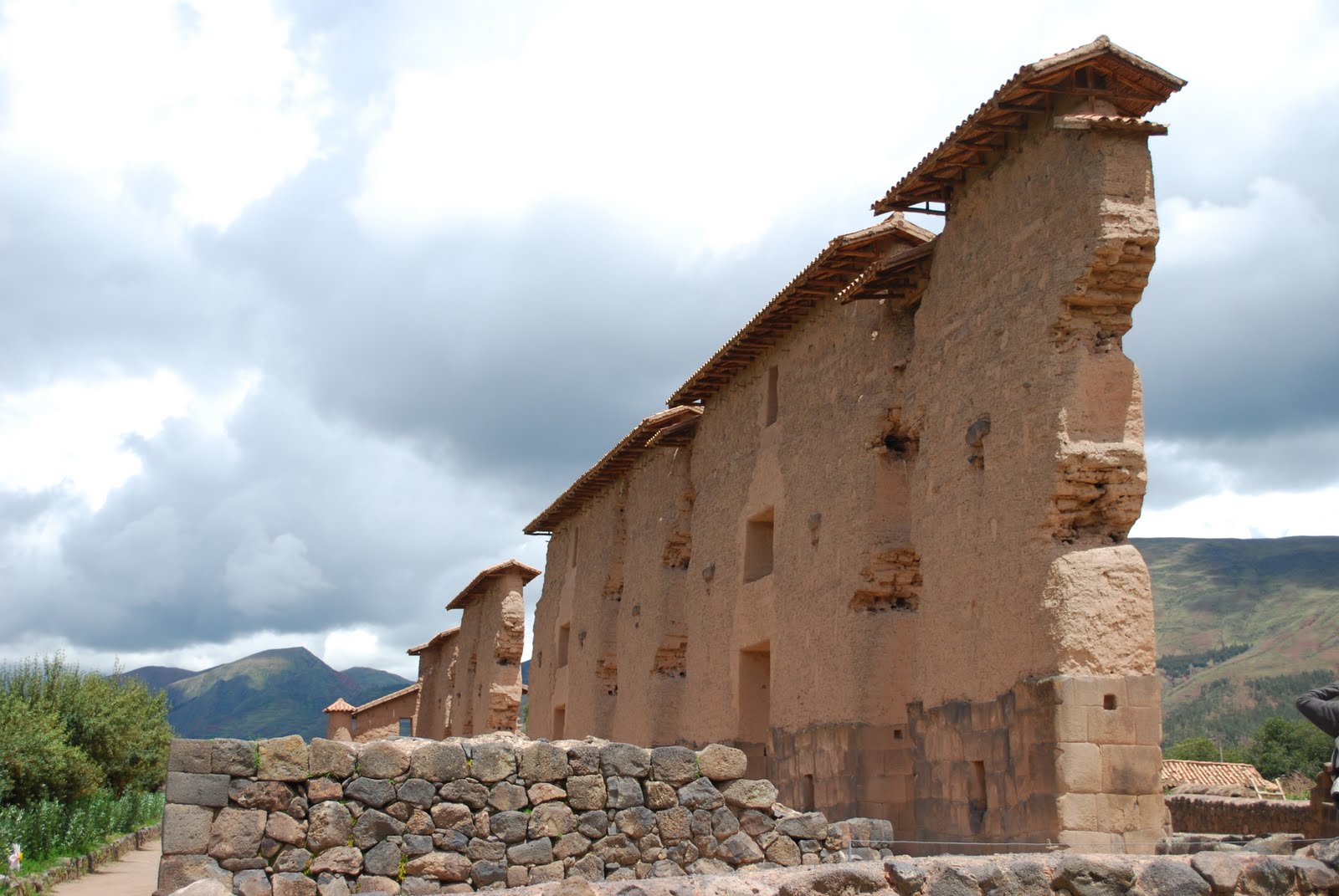
Between Cusco and Puno, we stop at Raqchi, a small pueblo on the Urubamba River that forms the entrance to the stunning ruins of an Inka temple. Amaru, a living Inka yachac, a traditional Inka shaman, holds an artist's rendition of what the qhapana might once have looked like. Both the temple and the surrounding complex are called the Temple of Wiraqocha (or Viracocha), the creator god of the Inkas and pre-Inkas. 
          The Spanish destroyed most of the temple structure, but this lone wall, shortened and damaged, still remains. Originally, it stood 20 meters high, forming the central wall of a huge two-story structure, 92 meters (302 feet) by 25.5 meters (84 feet), flanked by eleven columns and an outer stone wall on each side. The walls and columns supported what must have been the largest single roof in the Inka empire, spanning 25 meters (82 feet) on either side of the peak. The central adobe wall and columns, pierced by trapezoid windows and doors for passage from one side to the other, rested on andesite stone foundations measuring 4 meters (13 feet). Andesite is a volcanic stone with embedded crystals, the same stone that makes up the Andes mountains, for which it is named. 
          The temple was part of a heavily-populated tambo, "place to rest," spread across 264 hectares. In addition to the qhapana, the complex included twelve living quarters for priests and administrators, 100 round stone qolqas for storing grain, astronomical observatories, ceremonial fountains and enclosing walls. As we pass through the ruins we watch a number of workers busily restoring the central temple wall, which still stands like a sentinel to the sun.

Wednesday, June 15, 2011

yachac Amaru


yachac Amaru
sends healing light from Killa, 
Inka moon goddess

After performing a group ceremony at the Temple of the Moon, Amaru gives a healing to one of our members. Amaru is a traditional Inka yachac, or medicine man. In Inka mythology, Killa, the moon goddess, is the sister of Inti, the sun god. This beautiful open-air temple contains elements of both of these deities in the form of a fajcha, waterfall, associated with the feminine moon, and a carving of the sun on one of the large boulders.

Tuesday, June 14, 2011

on a rain drenched hill


on a rain drenched hill
the bus gets mired in mud
among curious cows


On our way to the temple of the moon, the bus turns off the highway at a little Juntos pueblo with its one wide stone paved street. Beyond the pueblo the road turns into a dirt track winding through pastures as it climbs the steep hill. It's been raining and threatening to rain some more. The bus goes slower and slower the higher we climb. We start to pass a herd of cows when suddenly the bus slides off the road onto the grass, tilts to the right and stops, with the front wheel sinking into mud. The driver tries to back up but the wheels just spin, digging in deeper. We all pile out of the bus to lighten the load, but it's no use, the bus is really stuck. Animated discussion between the driver and Amaru. Finally, Amaru motions us to trek on up the mountain where we come to the secluded site of the temple of the moon with its lovely waterfall. After a ceremony and meditation, it starts to rain again and we reluctantly leave this special spot to walk back down to the bus. A couple of indigenas have brought a wheelbarrow full of stones in an attempt to fill in the deep ruts dug by the tires, but to no avail. Amaru pulls out his mobile phone to arrange for another bus to pick us up at the highway. Silently I say thanks to Claro, the mobile phone company, for providing service to this remote area. We hike back down the hill in the rain to the pueblo to wait for our bus. I am completely soaked from my immersion in the waterfall and from the rain, but after my experience at the temple of the moon, the whole adventure with the bus just seems like an amusing episode in a film. 

Monday, June 13, 2011

round red claro signs


round red claro signs
adorn a blue wall, red door,
light casting shadow

Next to si, claro is probably the most often used word in Spanish. As an adverb it means, clearly, sure, of course. Claro que si is often used as an expression of agreement, yes, of course. As an adjective, claro has the additional meaning of light in color. Claro has been cleverly adopted as the name of a mobile phone company in South and Central America. The round red Claro signs, with little rays of white light above the o, are seen everywhere. The sign on this building, with its cerulean blue walls and carmine door, announces an authorized distributor. The faces and slogans pasted on the post outside are presidential campaign posters. I wonder what the graffiti sprayed on the wall means. Perhaps, where there is light, there is also shadow.

Sunday, June 12, 2011

sweet passionfruit


sweet passionfruit,
sensuous on the outside,
sublime on the inside


I acquired a passion for passionfruit in Peru, where it is called granadilla. When I encounter this pile of delectable orange orbs at the Pisac feria, I am tempted to purchase the whole lot. Granadillas are the edible fruit of subtropical Andean passionflowers. The "passion" part of passionflowers refers to the passion of Jesus in Christian theology. In the 15th and 16th centuries, Spanish Christian missionaries adopted the unique physical structures of the flower as symbols of the last days of Jesus and especially his crucifixion. The Spanish name for the fruit, granadilla, is the diminutive of granada, pomegranate, which derives from Latin granatus, seedy, and both fruits certainly do contain many seeds. The ripe fruit is about the size and shape of a lemon. The orange-yellow rind is smooth, thin and brittle on the outside, white and soft on the inside. The pulp is whitish-yellow, mucilaginous, juicy, with a sprightly, aromatic flavor, and encloses numerous flat, black, tender seeds. The slimy pulp is very sweet, but don't think about what it might look like. You can cut the shell in half and eat the contents with a spoon. Or you can crack the shell with your fingernails and suck out the soft, moist, sticky mass.

Friday, June 10, 2011

she's painting rainbows


she's painting rainbows
from tins of brilliant powdered
pigments piled in peaks


Colors, colors, colors! As an artist, I want to buy everything this vendor has on her table at the Pisac feria. I also want to know what they're made of. Where on Earth do they get that electric blue? These pigments are not synthetic, but I can't think of any rocks that are that color. The crimson red I do know about. It's made from cochineal, an insect native to South America that lives on cacti. The insect produces carminic acid as a defense against predators. Carminic acid can be extracted from the insect's body and mixed with calcium salts to make carmine dye. The bright red dye has long been used for coloring fabrics and was an important export during the colonial period. Its use declined with the invention of synthetic dyes, but recently there has been an increased demand for natural dyes and Peru is now the largest exporter. This brilliant carmine color is frequently used in the traditional clothing of Peru, from hats to ponchos, k'eperinas, shirts and skirts.

Thursday, June 9, 2011

still life with white flowers


still life with white flowers,
crewelwork tapestry and
chulucanas vase


In an artisan's shop in Ollyantaytambo, we admire the collection of art. The pink and black wall hanging is a beautiful example of crewelwork, a type of free embroidery with wool yarn applied to wool cloth. The designs include abstract lines and a stylized condor with two Inkas in ceremonial dress on either side. The black and white vase is an exquisite example of the pottery made in Chulucanas, a pueblo on the north coast of Peru, by descendents of the Tallanes, pre-Columbian peoples. The pottery is created through a unique multi-step process. Several techniques are used in the forming. Then a base slip is applied and the piece is burnished three times with river stones. After drying, the piece is fired in a wood-fired kiln. Next, the piece is decorated in a reverse method in which slip is applied to the parts to be left intact. A resin is also applied to give the piece its characteristic brilliance. Several more firings in a smoke kiln with mango leaves darken the uncovered areas. Then the slip is removed and a final wax finish is applied. When completed, each item is signed by the artists who created it. Simple and stunning.