Showing posts with label yachac. Show all posts

Tuesday, June 28, 2011

brown bottles and jars


brown bottles and jars
of homemade oils and ointments
fill his portable shop

When I first spot this man, he is standing at the entrance to the Pisac market, holding open his wooden case filled with little bottles and jars. I am not about to buy anything out of a hand-labeled container. Later he shows up at our restaurant and our medicine man guide Amaru introduces him as a friend. Our yachac tells us that this man's family makes these incredible essential oils and ointments on their farm and urges us to give him some business. Now I'm curious. My mother was an accomplished herbalist and I want to know more about the medicinal plants of the Andes. The man speaks some English and the labels are in Spanish. On the label it says: Insituto de Ecologia Y Plantas Medicinales, Comite Productores Ecologicos Del Valle Sagrado De Los Incas. Sounds good. He opens some bottles and jars, and I sniff the contents. Heavenly! I'm particularly drawn to Pomada de Chiri-Chiri. The label says it's good for dolores musculares artriticos, golpes y contusiones. I figure that means arthritic muscles and bruises. Great. Since I usually have sore muscles somewhere and bruise easily, I end up buying seven jars. And it works!

Monday, June 27, 2011

man with long gray hair


man with long gray hair,
smoking ch'aque khuri amidst
fossils, feathers, spheres


This man smoking a brown, hand-rolled cigarillo looks like an old hippie with his long gray hair, fringed poncho and crystal pendant. Perhaps he is a yachac, a medicine man. His shop is filled with shamanic items: condor feathers, crystals, fossils, staffs and beads. I am not sure about the function of the polished spheres made of semi-precious gemstones -- turquoise, hematite, quartz -- but they are beautiful to sight and touch. The little shop vibrates with the frequencies of all these sacred items, mixed with the fragrance of Andean tobacco, called ch'aque khuri in Quechua and c'jama saire in Ayamara.

Friday, June 17, 2011

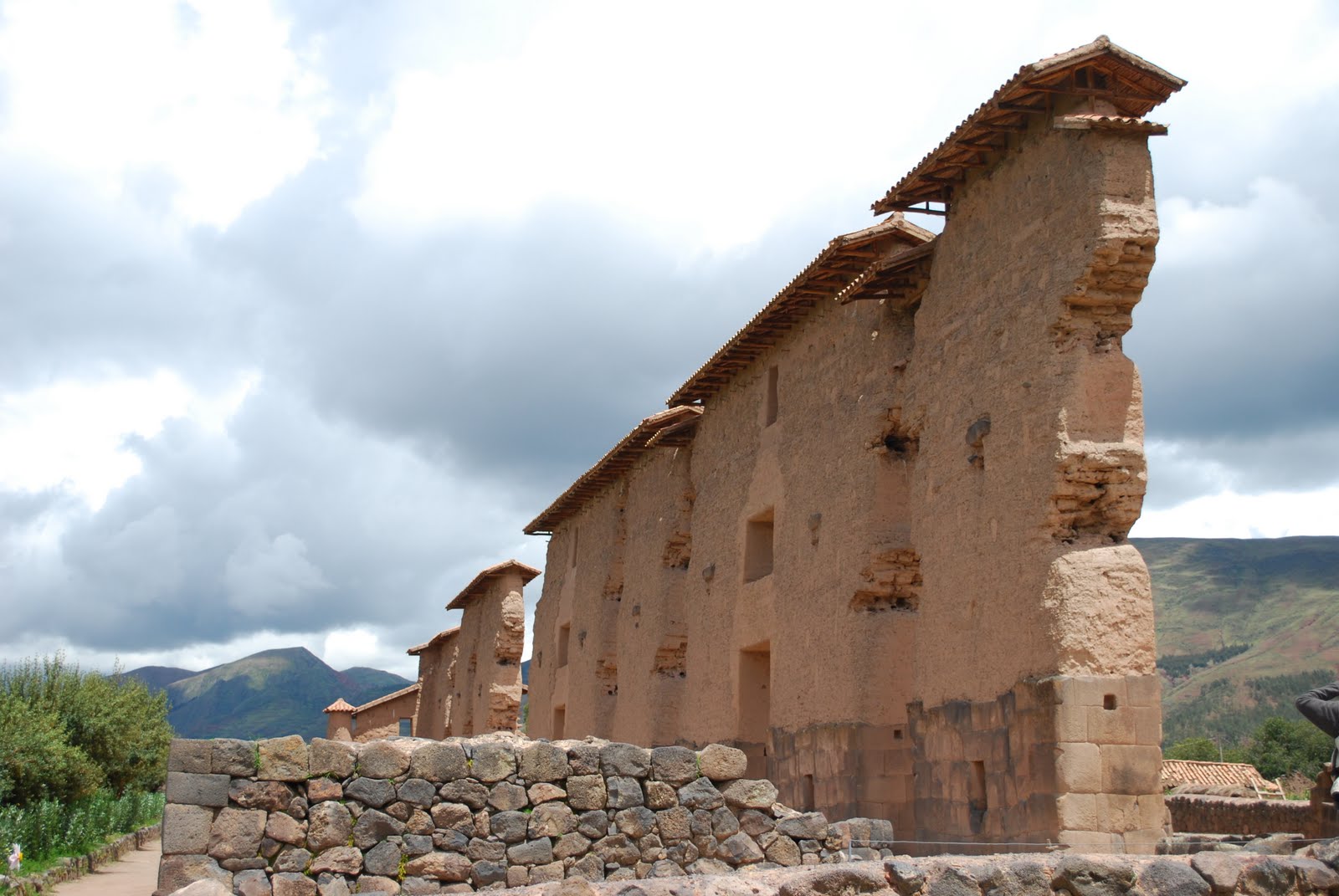
ruins of Wiraqocha


ruins of Wiraqocha
Temple, one gigantic wall
still raised to the sun


Between Cusco and Puno, we stop at Raqchi, a small pueblo on the Urubamba River that forms the entrance to the stunning ruins of an Inka temple. Amaru, a living Inka yachac, a traditional Inka shaman, holds an artist's rendition of what the qhapana might once have looked like. Both the temple and the surrounding complex are called the Temple of Wiraqocha (or Viracocha), the creator god of the Inkas and pre-Inkas. 
          The Spanish destroyed most of the temple structure, but this lone wall, shortened and damaged, still remains. Originally, it stood 20 meters high, forming the central wall of a huge two-story structure, 92 meters (302 feet) by 25.5 meters (84 feet), flanked by eleven columns and an outer stone wall on each side. The walls and columns supported what must have been the largest single roof in the Inka empire, spanning 25 meters (82 feet) on either side of the peak. The central adobe wall and columns, pierced by trapezoid windows and doors for passage from one side to the other, rested on andesite stone foundations measuring 4 meters (13 feet). Andesite is a volcanic stone with embedded crystals, the same stone that makes up the Andes mountains, for which it is named. 
          The temple was part of a heavily-populated tambo, "place to rest," spread across 264 hectares. In addition to the qhapana, the complex included twelve living quarters for priests and administrators, 100 round stone qolqas for storing grain, astronomical observatories, ceremonial fountains and enclosing walls. As we pass through the ruins we watch a number of workers busily restoring the central temple wall, which still stands like a sentinel to the sun.

Wednesday, June 15, 2011

yachac Amaru


yachac Amaru
sends healing light from Killa, 
Inka moon goddess

After performing a group ceremony at the Temple of the Moon, Amaru gives a healing to one of our members. Amaru is a traditional Inka yachac, or medicine man. In Inka mythology, Killa, the moon goddess, is the sister of Inti, the sun god. This beautiful open-air temple contains elements of both of these deities in the form of a fajcha, waterfall, associated with the feminine moon, and a carving of the sun on one of the large boulders.

Sunday, June 5, 2011

condor and yachac


condor and yachac,
wings and arms outstretched, dancing
on a floating island


The Andean Condor, the national symbol of Peru, has the largest wingspan of any land bird (3.2 m or 10.5 ft). It is also one of the longest living birds, with a lifespan of up to 100 years. A carrion feeder, it prefers high, open areas where it can soar on thermals while searching for carcasses of large animals. In Inka culture, Malku, the Condor, is a symbol of power and health, the ruler of the upper world, associated with Inti, the sun deity. Many Andean cultures believe that the bones and organs of the Andean Condor possess medicinal powers, which sometimes leads to the hunting and killing of condors. This female condor was shot but managed to land on the sanctuary of one of the Islas Uros, the floating islands of Lake Titicaca. When we arrived for a visit, the inhabitants asked our Inka guide, Amaru, a yachac or medicine man, to fix the bird's broken leg. Afterwards, the two did a dance together. Thanks to Coral Morales for these amazing photographs.

Wednesday, May 4, 2011

Pachatata sunrise


Pachatata sunrise –
a yachac offers Inti
red and yellow flowers

On the twin peaks of Amantani Isla in Titicaca Cocha, there are two temples, one to Pachamama, Earth Mother, and one to Pachatata, Earth Father. We begin our climb to Pachatata temple at 4:30 am in order to arrive before dawn. At the ancient stone temple, our Inka medicine men prepare for the sunrise ceremony. They have brought their flutes, yachac headdresses, and bags of coca leaves and kutata blossoms. They gather petals from a yellow wildflower growing on the hillside, thanking each flower for its offering. With the flowers they create a beautiful pattern on the ground in front of the temple gate, forming a double circle with the yellow petals to represent Inti, the Sun god, and a double heart with the tubular red blossoms for Pachamama, Inti's wife. As the rays of the sun stream out between the sapphire lake and the blue-gray clouds, Amaru leads us in a ceremony to greet the life-giving light.

Monday, April 25, 2011

temple of the moon


temple of the moon –
Pachamama murmuring
in the waterfall


Amaru, our Inka guide, has been leading us to places very few people ever visit, and the Temple of the Moon is one of my favorites. This ancient temple to Pachamama, Earth Mother, sits high on a hill, miles from anywhere, guarded by an apu, a mountain spirit. The bus toils up a muddy road and gets stuck three axles deep in a cow pasture. We climb the rest of the way to the site, where Amaru, a yachac or medicine man, performs a ceremony to allow us to enter the stone walls enclosing the sacred fajcha, Pachamama's waterfall, cascading at the far end. It is beginning to rain. Most of the group seeks shelter under some huge boulders to meditate, but I sit on a little bridge over the stream pouring down into the fajcha, with rain pattering down my poncho. Afterwards, I descend to the pool below the waterfall, step up to the falls and thrust my whole body into the cold, rushing water, which nearly knocks me off my feet. I emerge, completely soaked, my whole being resonating with the murmuring of Pachamama. When we return to the bus, local campesinos have failed to extricate it with shovels and stones, so we hike down to the highway to wait for another bus to pick us up. I am cold and wet but completely happy.

Wednesday, April 20, 2011

the deep blue waters


the deep blue waters
of rock puma lake lapping
earth mother's fingers


Amaru, our Inka shaman, tells us that Titicaca means Rock Puma. This massive lake, which sits at 3,800 m (12,500 ft), is sacred to indigenous Andeans, who believe that Viracocha, the creator, brought light to the world by raising Manco Capac, the sun, and his half-sister wife, Mama Ocllo, from the lake into the sky. These amazing rocks at Castle Beach look like porpoises or blue whales covered with barnacles. The rocks are actually red but the mottled coating of lichens and the light reflecting from the deep azure water makes them look mauve. I walked barefoot along the rocky shore for hours in the sun, which beat down with a fierce intensity at this high altitude. I slathered sunblock on my face but foolishly neglected my winter-pale feet. I woke up at night with my feet on fire, wishing I could soak them in that cold water again.

Friday, April 15, 2011

Pachatata temple


Pachatata temple –
Amaru, Cosmic Serpent,
hails the rising sun


When I wake up in the middle of the night, it is raining. My first thought is one of relief. Rain means we won't be getting up at 4:00 to climb five hundred feet in the dark to Pachatata temple at the top of the island in order to witness sunrise. My clock battery died so I have no idea what time it is, but I need to make a necessary visit to one of the two toilets that serve the entire hostel. I grope for my headlamp and pull on my alpaca sweater, cross the courtyard, climb several slick stone steps and pass the communal sink. The toilets are lit by one candle placed on the divider between the two. The hospedaje perches halfway up Amantani Island, which rises a thousand feet above the lake. At 12,500 feet, Lake Titicaca is the highest navigable lake in the world. It seems like only moments after I crawl back in bed before I hear a knock at the door. It has stopped raining and Amaru and Qoa, our Inka guides and medicine men, are ready to lead the way to the temple. I think about sleeping in, but when will I ever get a chance like this again? Fortunately, the path to the peak is paved with large flagstones. Last night we watched the locals, women and men, hauling these forty pound stones carried in bright square cloths on their backs up to the top in order to extend the path. The rest of the group takes off, leaving me alone with Qoa, who stays behind me, patiently waiting while I stop every few paces to catch my breath. We pass through several stone archways, each portal representing a chakra and a stage of initiation. When we finally reach the summit, we walk around a large square stone wall set with simple wooden gates. Pachatata, Earth Father, presides over this temple, while Pachamama, Earth Mother, has her own temple on an adjoining peak. Qoa asks us to stop, close our eyes and then walk forward, without fear, then stop again while he does a ceremony to allow us to enter the sacred space. At the eastern gate Amaru ties on his beaded yachac headdress, then sets about creating a beautiful mandala with red flowers forming a double heart and a solid circle of yellow flowers in the center for the sun. He leads us in several ceremonies, ending by playing his flute as the sun rises. Amaru means Cosmic Serpent and Qoa means Cosmic Puma. Malku, another of our Inka yachac friends, is named for the Cosmic Condor. These three animals form the triumvirate in the Inka spiritual realm. Their forms appear to me as I sit in meditation. Amaru says they are the guardians of these sacred sites.