Showing posts with label Inka shaman. Show all posts

Friday, June 17, 2011

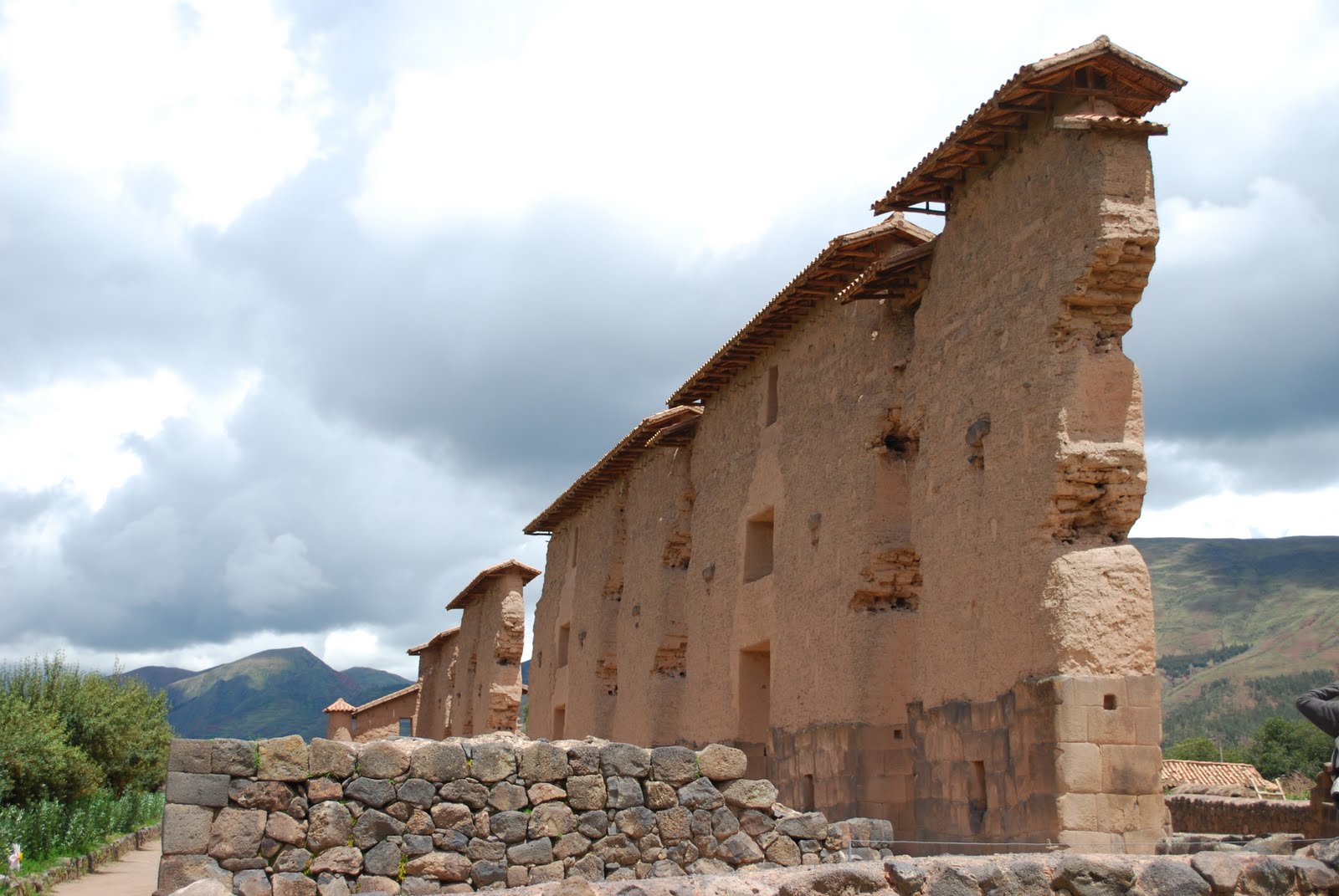
ruins of Wiraqocha


ruins of Wiraqocha
Temple, one gigantic wall
still raised to the sun


Between Cusco and Puno, we stop at Raqchi, a small pueblo on the Urubamba River that forms the entrance to the stunning ruins of an Inka temple. Amaru, a living Inka yachac, a traditional Inka shaman, holds an artist's rendition of what the qhapana might once have looked like. Both the temple and the surrounding complex are called the Temple of Wiraqocha (or Viracocha), the creator god of the Inkas and pre-Inkas. 
          The Spanish destroyed most of the temple structure, but this lone wall, shortened and damaged, still remains. Originally, it stood 20 meters high, forming the central wall of a huge two-story structure, 92 meters (302 feet) by 25.5 meters (84 feet), flanked by eleven columns and an outer stone wall on each side. The walls and columns supported what must have been the largest single roof in the Inka empire, spanning 25 meters (82 feet) on either side of the peak. The central adobe wall and columns, pierced by trapezoid windows and doors for passage from one side to the other, rested on andesite stone foundations measuring 4 meters (13 feet). Andesite is a volcanic stone with embedded crystals, the same stone that makes up the Andes mountains, for which it is named. 
          The temple was part of a heavily-populated tambo, "place to rest," spread across 264 hectares. In addition to the qhapana, the complex included twelve living quarters for priests and administrators, 100 round stone qolqas for storing grain, astronomical observatories, ceremonial fountains and enclosing walls. As we pass through the ruins we watch a number of workers busily restoring the central temple wall, which still stands like a sentinel to the sun.

Tuesday, May 31, 2011

twin sun worshippers


twin sun worshippers
on Pachamama's lap, faces
turned to Tayta Inti


What a treat, a whole afternoon on Castle Beach on Lake Titicaca, beginning with a ceremony led by Amaru, our Inka shaman guide, to welcome us to step into the sacred lake, followed by a picnic lunch, games and just wandering the beach. So nice to slow down and do nothing after days of traveling, just lying on the warm rocks, soaking up the rays of Tayta Inti, Father Sun, on the lap of Pachamama, Earth Mother.

Saturday, April 23, 2011

Sacsayhuaman


Sacsayhuaman –
puma's head and zigzag teeth
guard llama herders


Sacsayhauman Temple, on the outskirts of Cusco, was dedicated to the Andean deity Illapa, the Ray of Lightning, an important symbol in agricultural rituals. For this reason, the outer walls of the temple were built in three zigzag tiers, representing lightning. Begun in the 15th century, the temple took a century to build. The massive stones fit together like a giant jigsaw puzzle, with no visible gap between the blocks. Amaru, our Inka yachac guide, tells us this was done by shamanic powers, and it is easy to believe this when you touch the stones. The original temple is said to be the head of the puma, the female Inka deity. These female Inka descendents still graze their llamas on the steep slopes, observing tourists as curiously as we observe them.

Thursday, April 21, 2011

on the isle of love


on the isle of love
a moon-faced baby peers out 
from his ruffled cap


On Isla Amantani I fell in love with this little boy, son of the family who run the hostel we stayed in. This circular island in Lake Titicaca is also called Isla Kantuta, after the national flower that grows here. Amaru, our Inka shaman guide, calls it the Love Island, because of the pair of peaks, each with an ancient temple on top to Pachamama, Earth Mother, and Pachatata, Earth Father. I saw evidence of this love theme in the heart shape set in the center of the white window grilles on the adobe houses. The costumes of the women and children are very bright, with multicolored embroidered skirts, blouses and shawls. In contrast, the men wear black pants, vest and hat with a white shirt. Unmarried children wear ruffled stocking caps, the boys with a white background and the girls in brown, both knit with colorful designs. This baby boy is obviously loved by his entire extended family and charmed us all.

Wednesday, April 20, 2011

the deep blue waters


the deep blue waters
of rock puma lake lapping
earth mother's fingers


Amaru, our Inka shaman, tells us that Titicaca means Rock Puma. This massive lake, which sits at 3,800 m (12,500 ft), is sacred to indigenous Andeans, who believe that Viracocha, the creator, brought light to the world by raising Manco Capac, the sun, and his half-sister wife, Mama Ocllo, from the lake into the sky. These amazing rocks at Castle Beach look like porpoises or blue whales covered with barnacles. The rocks are actually red but the mottled coating of lichens and the light reflecting from the deep azure water makes them look mauve. I walked barefoot along the rocky shore for hours in the sun, which beat down with a fierce intensity at this high altitude. I slathered sunblock on my face but foolishly neglected my winter-pale feet. I woke up at night with my feet on fire, wishing I could soak them in that cold water again.