Monday, January 31, 2011

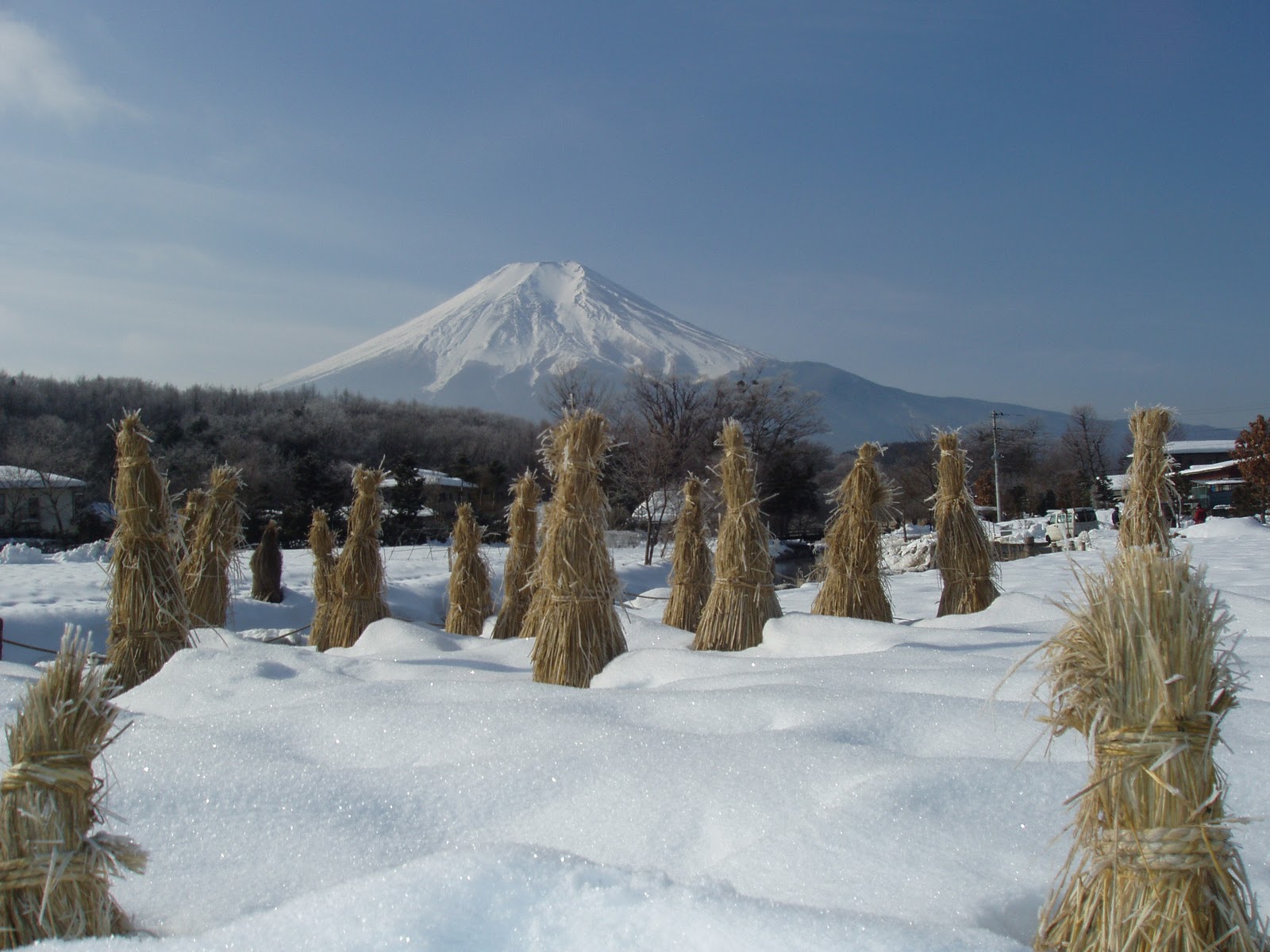
straw stacks sunk in snow


straw stacks sunk in snow –-
rising above the small peaks
Fujisan, cloaked in white

I am not the only photographer charmed by this scene. The parking lot next to this little field bristles with as many tripods as straw stacks. I am the only foreigner taking photos and I have no tripod, but I feel right at home. The scene reminds me of Hokusai’s Thirty-six Views of Mt. Fuji, particularly Tea House at Koishikawa, the morning after a snowfall. I fell in love with ukiyo-e artist Katsushika Hokusai at an early age and my house is filled with his beautiful colored woodblock prints. During my stay in Oshino, at the foot of Fujisan, I understand how a person could spend every day admiring the beauty of this magical mountain from many different viewpoints and through all the changing seasons.

Sunday, January 30, 2011

Fujisan under snow


Fujisan under snow –
an ice sculpture kneels beside
the pilgrimage road
 
Sensei’s house sits on the side of a small mountain with a view of Fujisan. Often I walk down the steep, winding road to the river. Ice sculptures line the road, looking like pilgrims dressed in white, suspended in ice, waiting for spring to release them so they can continue their pilgrimage.

fan print in the snow


fan print in the snow –
a bird landing with tail spread
leaves its signature

Walking to the mailbox, I notice a clear set of turkey tracks at the T intersection and stop to have a look. It doesn't take a tracker to figure out that three turkeys walked side by side through the thin snow on the road. Then I notice what looks like a fan print made by the tail of some bird with tiny feet. The bird must have landed with spread tail then daintily stepped away. These beautiful imprints, framed by wide tire tracks and big boot tracks, remain untouched by passing traffic. At first I think I’ll take some photos tomorrow, but then, knowing how quickly the weather changes around here, I walk back and grab my camera. Sure enough, the next day the prints have faded away.

Saturday, January 29, 2011

floating on crystal


floating on crystal
cirrus – fragment of rainbow
mocking the sun

This patch of rainbow appeared to the right of the low sun in the west. I call these bright spots sun dogs, because they follow the sun like a dog heeling its master. Others call them mock suns, because the bright patches look like the sun behind thick clouds. These colorful spots are caused by light refracting through six-sided crystals in a thin layer of cirrostratus, producing partial halos called parhelia, from the Greek “with the sun.” Often there will be a matched pair horizontally lined up with the sun in the center of a 22 degree ring, the angle that light is bent by the the ice. Sometimes the halo itself is visible. To the observer, the ring appears to have a diameter of about two fists held at arm's length. These small, bright rainbows floating at a distance from the sun are sometimes difficult to detect, and may come and go quickly, so it's fun to catch sight of them before they fade. This one was gone in moments as the patch of cloud moved away.

Friday, January 28, 2011

winter thaw -- white fog


winter thaw – white fog
rises up, muffling black trees,
snow-covered white lake

Yesterday the sun came out and the temperature rose above freezing, melting the ice on the road in ribbons where shafts of sunlight slashed through naked trees. This morning all that cold moisture took to the air as dense white fog, limiting my vision to a quarter of a mile on hills and less than half that in the valleys. The snow-covered lake looks like a mirror reflection – white above, white below. I walk in a hush through soft snow, stepping on animal tracks blurred and spread until they are barely recognizable. Everything is muffled, both light and sound.

Thursday, January 27, 2011

black hole in the ice


black hole in the ice –
deer drawn by open water
tread thin ice to drink

I keep wondering which comes first, the ice melting into a hole or deer breaking a hole in the ice. Often on the trail I see places where deer have pawed the snow away to grab snatches of grass, so I suppose their sharp hooves could break through thin ice. But perhaps the hole was made when a deer, walking on the frozen creek, accidentally broke through, and then the hole somehow got enlarged. In any case, once the hole is there, tracks show deer coming down the banks, crossing the ice and standing around the hole to lap up the cold water.

Wednesday, January 26, 2011

fragile frozen fog


fragile frozen fog
bristles sideways along each
evergreen needle

In the Western United States icy fog is called pogonip, from Shoshone pakenappeh.The fog on the white pine needles froze sideways, leaving fragile bristles like tiny toothbrushes or delicate downy feathers.