Friday, April 13, 2012

a bat trapped inside


a bat trapped inside 
echolocates its way to
the open window

Friday the thirteenth, a time of new beginnings. Playing the Maya turtle ocarina finally brought rain today, a soft, soaking, spring rain. Standing in the kitchen early this morning, looking out at the saturated hues of green, I catch something dark falling down on the other side of the window. A leaf? But it seems to be inside the sun room, not outside. I open the sliding glass door and immediately a small winged creature begins fluttering back and forth the length of the sun room. A bird? No, the movements are too quick. A bat then. 
          But how did it get in? All the windows are closed. Thinking fairly quickly for this early, I go out on the porch, remove the screen from one of the windows on the east end and open the window. The bat flies toward the windows but lands just above the closed window, clinging to the wooden frame. With a broom I gently coax the bat to start flying again, but it keeps missing the open window. Getting the message, I crank the other window open wide and this time the bat echolocates the opening and swoops out. Now we're wondering if the sounds we've been hearing above our heads are not squirrels or mice but a colony of bats that have been wintering between the roof and the ceiling. But how did this one get into the downstairs sun room?
          Bats are mysterious, but also beautiful and useful. I have always loved watching their graceful acrobatic flight on warm evenings as they catch enormous quantities of harmful insects, consuming a third of their body weight in half an hour. Coincidentally, this year is the Year of the Bat, as proclaimed by Bat Conservation International, and this week, 9-12 April, is Bat Awareness and Appreciation Week. I'm right in tune with the times, my early morning experience making me aware and also appreciative of bats, whether in or around our home.
          Bats continue to be in the news because of the threat of white-nose syndrome, a cold-loving fungus that has killed at least one million hibernating North American bats in the Northeast since 2006 and is spreading westward. In the rain-dark light this morning, I didn't notice whether our bat had a white nose. If it did hibernate in our house, it would certainly have been warmer than in a cave or one of the bat houses we have attached to our sheds. However, I will report our errant bat to the Iowa Department of Natural Resources, which is collecting information about unusual behavior in bats in the early spring when they emerge from hibernation, such as difficulty flying and flying during the daytime. Our little bat seemed to be flying normally and I'm sure it was flying in the daytime only because we disturbed its sleep.
          My other concern for the bats is our new wind turbine because a number of bat deaths have been reported under wind turbines. Researchers have found that the majority of bats were killed because a sudden drop in air pressure near blades caused injuries to the bats' lungs, called barotrauma. Respiratory systems in birds can withstand such drops but bat lungs cannot. Fortunately, scientists have shown that slowing turbine blades to near motionless in low-wind periods significantly reduces bat mortality. This makes sense because bats don't like to fly when it's really windy, which is when the turbines are reaping the most energy. So this system would be a boon for both bats and the production of energy from the wind. Hurray!

Thursday, April 12, 2012

a paper wasp probes


a paper wasp probes
the throat of a white flower
ignored by honey bees

A mated female wasp emerged a few weeks ago, during a hot spell in early spring, and began building a papery gray nest shaped like an upside-down umbrella in a corner of my second-floor window. I didn't notice until the new queen's eggs hatched into workers, who were busy adding to the open cells of the nest. Some of them managed to squeeze in through the crack between the window frame and the screen, getting trapped in my bedroom, not a comfortable situation for any of us. I opened the window, shooed them away from the nest with a broom and then knocked the nest off. They kept returning to the same spot for many days, but finally the queen began building a new nest higher up, under the eaves.
          Although their sting is painful, these wasps are usually quite docile unless they or their nest are attacked. This morning I find a worker climbing all over the white blossoms of a wildflower just outside our front door, probing for energy-giving nectar. The honey bees are bustling around the tree peony blossoms nearby, but none of the bees seem interested in this particular wildflower, leaving the job of its pollination to the wasp.
          When the wasp larvae hatch, the adults will forage for caterpillars, flies and beetle larvae to feed their young. Paper wasps are doubly beneficial to gardeners by pollinating flowers and eating pests. So I quietly leave this gold-striped beauty to her work.

head down in the golden


head down in the golden
anthers a honey bee collects
nectar and pollen

Mid-April and we've had frost the last few days. I left the fruit trees to their fate but did cover my potted house plants put out during the hot spell in March. The tree peonies are already in full bloom. In just two weeks they emerged from tiny, tight, purple-green buds into huge, flounced blossoms enclosing a golden tassel. This morning the fuchsia blossoms and the serrated green leaves hung limp, but by midday the flowers have lifted their faces to the sun. 
          Honey bees, attracted by the bright pink petals, are diving headlong through the fringe of golden anthers at the center of each flower to reach the nectary with its sugary solution. In the process, the pollen gets stuck to the bee's hind legs. As the bee crawls around it deposits pollen grains on the sticky pink stigmas, either on this blossom or another one, thus fertilizing the ovules at the base of the the stigma. 
          One bee keeps diving into the folds of the petals, fruitlessly seeking the path to the source of sustenance. She finally finds her way to the mother lode, already being mined by a fellow forager. 
          By late afternoon the magenta petals have closed over the golden heart of each blossom. One lone bee keeps searching for entrance, but the flower seems to be saying, "Closed for the day, come back tomorrow when the sun is overhead."

Wednesday, April 11, 2012

children of Cozumel


children of Cozumel,
surrounded by turquoise sea,
tourists with cameras


Their mothers sell braided bracelets and belts to tourists who come to the island for diving, shopping, seaside cuisine. The children of Cozumel, surrounded by a sea of turquoise water and tourists, play like children everywhere, exploring their little patch of land, enjoying a cold drink and the gift of a bracelet made from balloons. The balloons may not last longer than the crushed ice, but the moment is innocently sweet.

Tuesday, April 10, 2012

blowing through the hollow


blowing through the hollow
body of a clay turtle
a shaman invokes rain


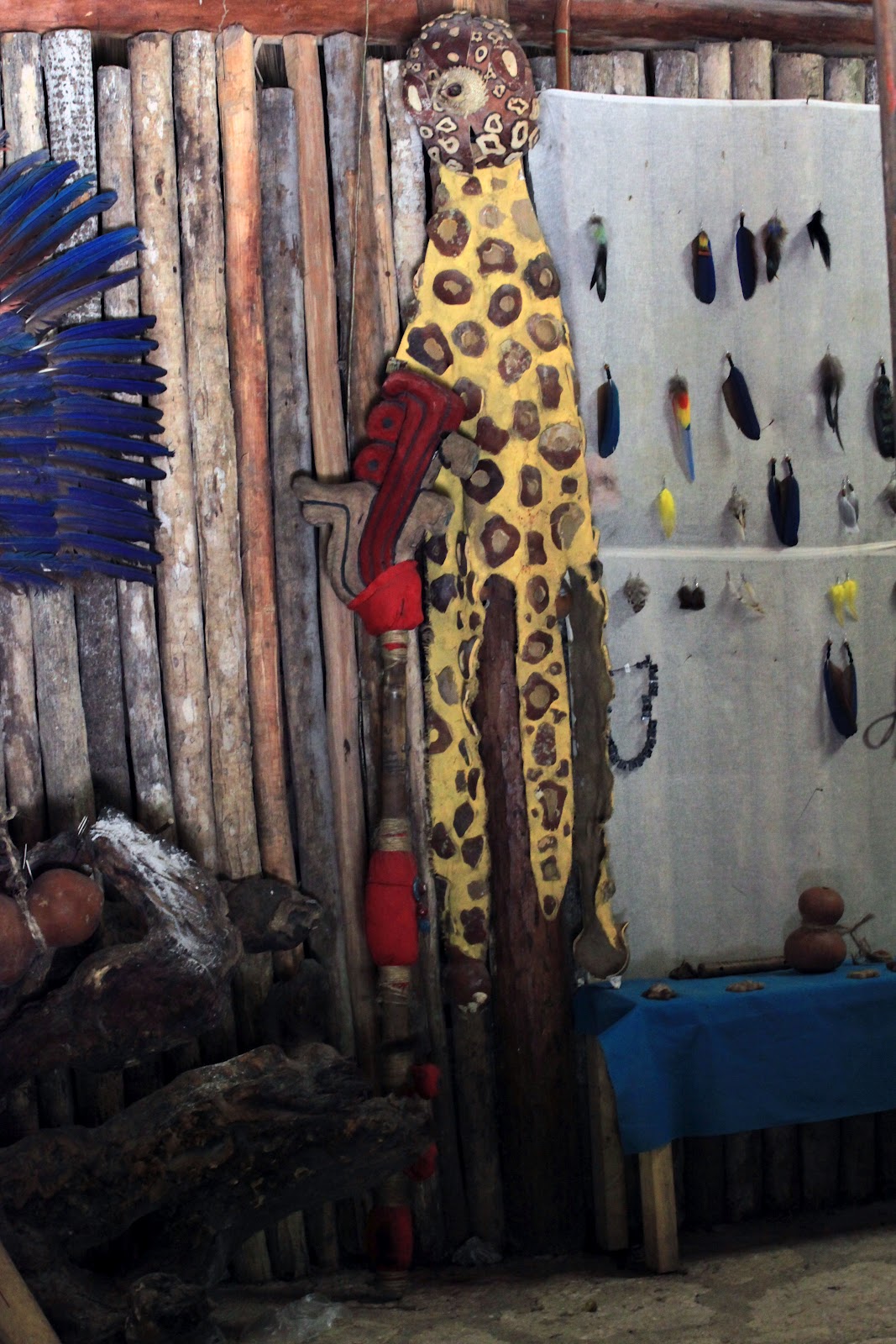
As soon as my friend and I enter Xcaret, a huge Yucatan theme park, we head for the area called the Maya Village, hoping to see how the ancient Maya lived. I am pleased to find a group of Maya artisans practicing their crafts, from wood carving to weaving to painting. At one little shop, a man makes beautiful feather jewelry.
          The artisan, who is wearing a necklace of large tubular coral beads, tells us that feathers are very important to the Maya. As we consider which of the beautiful sets of feathered earrings to purchase, he points to each type of feather and reverently pronounces the name of the bird in Maya. 
          He also sells terracotta ocarinas. This sonorous device is basically a flute with a globular body capable of varying ranges of tone and pitch. Many ocarinas have been found in archaeological digs and it seems likely that they were used in ancient Maya rituals of agricultural and fertility cults and burial ceremonies. The artisan picks up a large ocarina in the shape of a turtle and demonstrates how to play it. The tones are deep, resonant, a suitable sound for the mythical Turtle believed to uphold the Earth. He tells us that this sound is used to invoke rain. We had a drought last year. The turtle ocarina is soon safely wrapped and stowed in my backpack.
          I wander inside the shop, which is full of ritual items: headdresses, shields, drums, censors, costumes. I long to ask him about each fascinating object, but he speaks mostly Maya and my Spanish is very limited. So I content myself with admiring the wealth of native culture, which vibrantly alive on in this modern age.


Monday, April 9, 2012

before the entrance


before the entrance 
to the underworld, the shaman
burns copal incense

Miguel, our Maya guide who works for AllTourNative, an eco-tourism company, drives our group to Ek Balam, a Maya village way back in the jungle, where the villagers live in thatch-roofed huts with wooden walls and speak only Maya and pidgin Spanish. After a delicious buffet of chicken, potato enchiladas, rice, black beans, squash soup, hibiscus tea and rice milk, we we walk to a small cenote, a freshwater sinkhole in a limestone cave. 
          Before we can enter the sacred waters, the village shaman, dressed in white shirt and pants, conducts a purification ceremony. Adolfo is short and compact, with golden brown skin, black hair graying at the temples, a thin gray mustache above a perpetual smile and sparkling black eyes. We stand in a semi-circle in front of the altar constructed of green branches, which holds offerings of squash, maize, beans, peppers, cactus fruit and flowers.
          Miguel explains that the Maya world view consists of the underworld, the middle world and the upper world. The cenotes are considered to be the entrance to the underworld and the purification ceremony shows respect to the aluxes, or spirits of the cenote.
          Adolfo lights copal incense, called pom, in a wooden chalice wrapped in vines around the top. Miguel explains that the copal, made from hardened sap, is for protection as well as purification. With Miguel interpreting, Adolfo asks each of us where is our home country, which he blesses during the ceremony. He waves a leafy branch in the four directions and chants in Maya, a sound that resonates pleasantly up my spine. Then he wafts the sweet-smelling incense over our heads.
          After the ceremony we take a shower and don climbing gear for descending into the cenote. The round opening is about 15 feet (4.5 meters) in diameter and the distance to the water appears to be about two stories down. We are given the choice to rappel down or be lowered down by two ropes. With my sore shoulder, I opt to be lowered. A man at the bottom gives us an inner tube, but I quickly abandon mine to swim about freely in the clear, cool turquoise water and explore the perimeter of the cenote. There's a low opening on one side that leads to the underground river which feeds the cenote, but we're cautioned not to enter. The last one to be hauled up, I emerge feeling truly purified by my immersion in the pure waters.

Sunday, April 8, 2012

with the finest brush


with the finest brush
Oswaldo paints the Maya lord
of the wheel of time

At the Maya Village in Xcaret, a big Yucatan theme park, I watch Oswaldo applying brilliant color to a square of soft leather with the finest of brushes, the same type of brush I use for miniature gouache paintings. His attention is totally focused on making careful, tiny strokes, undisturbed by all the activity around him. His wife, Ascuncion, wearing a traditional white dress with floral embroidery, stands protectively behind him.
          The painting Oswaldo is working on depicts the Haab', the solar Maya calendar of 365 days, divided into 18 counts of 20 days with a count of 5 days at the end, which were considered unlucky days. This solar wheel shows the Maya lord of time at the center, supporting the burden of time on his back, represented by a glyph called ajaw, the name of the 20th day in the Tzolk'in calendar, and surrounded by the hieroglyphs for the 19 counts.
          The names of the 19 counts reflect aspects of the seasons of the solar year: mat, black conjunction, red conjunction, bat, watering time, dog, new sun, water, black storm, green storm, white storm, red storm, enclosed, yellow sun, owl, planting time, turtle, granary, resting of the year. However, because the Haab' does not take into account the extra quarter of a day in each solar year, the correspondence to the seasons would wander over the years.
          The Maya calendar is actually a system of calendars. The Calendar Round of 52 solar years includes the Haab' year of 365 days and the Tzolk'in, or Sacred Round, composed of 13 counts of 20 days, with each day having a unique name. For longer time periods, the Maya use the Long Count, which covers any length of time, past or future.
          This year the Maya calendar is getting a lot of attention everywhere because the Long Count of 20 b'ak'tuns, 7,885 solar years, will end on 21 December 2012. But rather than indicating a cataclysm, this is simply the day that the calendar will go to the next b'ak'tun at Long Count 13.0.0.0.0. 
          The cyclical nature of time was important to the Maya, who believed that each cycle had a particular character, which would influence events within that cycle, and the completion of one cycle and the recurrence of the next cycle was marked with ceremonies. So it will be interesting to see what influence the new Long Count of 20 b'ak'tuns will bring to the Earth and its inhabitants.
          I have a feeling that Oswaldo will celebrate on 21 December, and then return to his own cycle of painting.