Tuesday, May 31, 2016

on the road with Evan


on the road with Evan --
tiny house inside handmade 
camper painted blue

The open hatch of the pickup camper parked outside on campus draws me to peer in. It's a tiny house inside, complete with a raised bed (storage underneath), an ice chest and big water jugs. What really perks my attention is the row of quart glass Mason jars suspended from their metal caps, which must be screwed into the shelf above them. Very efficient use of space! What inventive person created this?


Two friends join me to marvel over this little home on wheels. The owner appears and we introduce ourselves. Evan is a lanky young man, originally from New York, but recently from Oklahoma. My friends, Andrew and Katia, are from Australia and Germany. "Are you from Germany?" Evan asks me. "I'm local, very local." Evan has come to Maharishi University of Management for a visitor's weekend, thinking about moving here to enroll in the Sustainable Living Program. If he does, he'll live in his camper, at least for awhile. "Until it gets cold," I say. Evan points to the small electric heater at the other end. "That keeps things really toasty, and I'm planning on getting backup batteries." 


Light shines through a skylight in the plywood ceiling. Netting keeps items from falling off the shelf at the far end, while a cord keeps the overhead compartments along the side from opening in transit. Evan cooks on a one-burner hot plate. He's also planning on getting a small electric refrigerator to replace the ice chest. Ah, the lure of the convenience of electricity. Maybe he could put solar panels on the roof.


Yes, he built the whole camper himself. The plywood exterior is painted blue, a fitting color for a man who travels a lot under the wide blue skies of our country.

Saturday, May 28, 2016

raccoon sleeping

Zx

raccoon sleeping
battered legs stretched out of the cage
after a long night

It's the third raccoon we've caught in the past couple of weeks. The masked bandits have been marauding the bird feeders. Jumping from the bench, they hang on to a feeder until their weight brings it crashing to the ground, seeds spilling out. I've started bringing the feeders in at night, but sometimes I wait too long past dark. Then we hear the bang bang of the big green feeder against the window. As soon as we open the door, a striped form drops to the ground and streaks away. One time John got out so quickly that he kicked the coon as it ran past him!

So John started setting the humane trap, baiting it with nut butter. When the animal goes into the cage to eat the bait, it trips a spring and the door shuts, locking it in. At first John put a glob of the stuff in the trap, but the small chipmunks easily carried it off without springing the door. So now he just smears some in the cage. It works.


This morning when I went out to replace the feeders, I found a raccoon in the trap. It was lying on its side, tucked under the angle of the door, front legs stretched out through holes in the cage. Its legs were bloody from trying to escape. At first I thought the coon was dead. It didn't stir with all the noise I was making. But then I saw its side rising and falling, still breathing, so it must have been asleep, exhausted from its struggles. Soon afterwards I saw it sit up and begin licking its wounds. 

I urged John to take it to Turkey Run as soon as possible. This is a public wildlife area some miles south across the river. I always worry about the animals not having water. When we went out to collect the cage, the raccoon sat up from another nap and looked anxiously up at these two huge humans. As soon as John picked up the cage, the coon started pacing back and forth, trying to get out again. John said when he got to the river and opened the door, the coon jumped out and dashed away. The second one we caught got turned the wrong way in the cage and took longer to leave. John tried banging on the cage, but the coon just growled and tried to bite through the bars. Finally, it got turned the right way and jumped out. 


When we caught the first coon, it had been raining all night. The poor critter had rolled the cage over from the plywood to the dirt, which was now mud. It kept trying to dig its way out and managed to pull a pile of mud into the cage and cover its fur with mud. In the morning John took the cage over to the outdoor spigot and hosed the raccoon off. It opened its mouth and drank some of the water, holding one paw up, as if begging for deliverance. 

I really don't like these so-called humane traps. It's true, it doesn't kill the animal (unless it's left in it too long), but the creature certainly goes through a lot of suffering before it's released. And then I always worry that it may be a mother with babies left behind. It's hard to live in the country and not come into conflict with the animals who naturally live in the woods and meadows around us. But if it were up to me, I would just be more vigilant about taking the feeders in before dark and not set any traps.

Saturday, May 14, 2016

striped hood curving back


striped hood curving back 
over a gold-spotted wand --
jack-in-the-pulpit

On my weekly walk in the woods last week, I'm surprised as I almost step on a Jack-in-the Pulpit growing in the middle of a clearing where a neighbor will be building a house. Near a blackened, burned stump, two Arisaema triphllum are in bloom amidst a little colony of smaller plants. These herbaceous perennials usually grow only in shaded woods, as this area once was for many years. However, the trees have been cut to make way for the house and no one told the wildflowers not to carry on. So there they are, in full bloom.

This wildflower grows in an interesting way. The part that we think of as the flower, the "Jack" in the "Pulpit," is actually a tall phallic stalk, or spadix, inside a hooded vase, or spathe. Aris is Greek for Arum, which means an amorphous phallus. Haima means blood. So Arisaema could mean blood relationship, that is, "akin to Arum." Or it may refer to the bright red berries that appear in a bundle on the stalk after the spadix dies back in autumn. Triphllum means three leaves, as each plant's single umbrella leaf has three pointed lobes. The actual flowers are tiny yellow dots covering the spadix, male on top, female below. This is a very sexy plant, as we shall see.


I want to save these wildflowers from the building that is going up soon. What to do? I'm tempted to dig them up immediately. One inner voice says, "Go home and get your hori-hori knife and a pot." Another voice says, "They're on someone else's property. You need to get permission first." When I get home, it starts raining hard, so my conscience wins that day. On Friday I get an email saying construction will begin in a couple of weeks. Yikes! I don't have the owner's email, so I send a message to his mother. No response. 

On Saturday I take another chipmunk caught in our humane trap down to Pilgrim Creek to release -- same place as the last one, maybe they'll find each other. This time I take my hori-hori with me. One voice says, "It's alright to dig just one tiny plant, no one will notice, and you'll be rescuing a rare plant from certain destruction." The other voice says, "Don't do what you know is wrong." When I get near the clearing, I hear a low machine noise. Oh no, the owner is mowing with a brush hog! Fortunately, he hasn't reached the Jack-in-the-Pulpits. He stops when he sees me and I tell him about the rare wildflowers and ask if he would move them out of harm's way.  He says, "If you want to do that, go ahead." Quickly I dig up two dozen plants and transplant them into my wildflower garden, a moist, shady spot with rich, slightly acid humus, in a circle of limestone blocks, safe from the mower.


Here we see the large three-lobed leaves, with the top of one spathe peeking through the gap between two sets of big leaves. Each corm gives rise to a stalk which splits to form the leaflets and the spathe.

Native Americans knew not to eat either the berries or the corms raw, as the calcium oxalate crystals cause burning in the mouth and throat. They did gather the roots, and removed the toxins by peeling, grinding, drying and roasting to make a bread or cereal, or slicing and roasting the wafers. After roasting, the roots have a chocolaty flavor. The Native Americans apparently did not roast the berries. 

I'm looking at the tiny bulb-like roots and wondering how the Native Americans ever harvested enough for food. Even the two biggest blooming plants have a corm the size of an acorn. I notice that one of the corms has two little "horns" protruding from each side. This is how the plant propagates vegetatively, by sending out "cormlets." The other method is by sexual reproduction, with insects transporting pollen from the male flowers to the female flowers, which then form seeds. The "hood" protects the pollen from being dispersed by wind, while the separation of male and female flowers prevents self-fertilization. In addition, each plant has predominately either male or female flowers, which mature at different times.

On top of all this, the plant also engages in "sequential hermaphroditism." A seedling spends four to six years in a pre-reproductive state before it's big enough to produce flowers, which are male. In following years, as the spadix gets bigger, it starts producing female flowers, able to make fruit, some of which may contain viable seeds. Environmental conditions, such as available nutrients and supportive habitat, also determine the transition from male to female. I wonder if this is where Ursula Le Guin got the idea for sequentially hermaphroditic humans in The Left Hand of Darkness. It would be a very interesting way to live.

Environmental stresses will cause the plant to revert from female back to male, or even to its pre-reproductive state. I can't help wondering what global warming will do to these plants, along with so many others.

Sunday, April 24, 2016

curving back on red


curving back on red 
stem, lily petals rocket
from yellow stamens

The angel wings of Duchman's Breeches have flown away. Where they touched the earth, pink and white Spring Beauty polka-dot the ground.


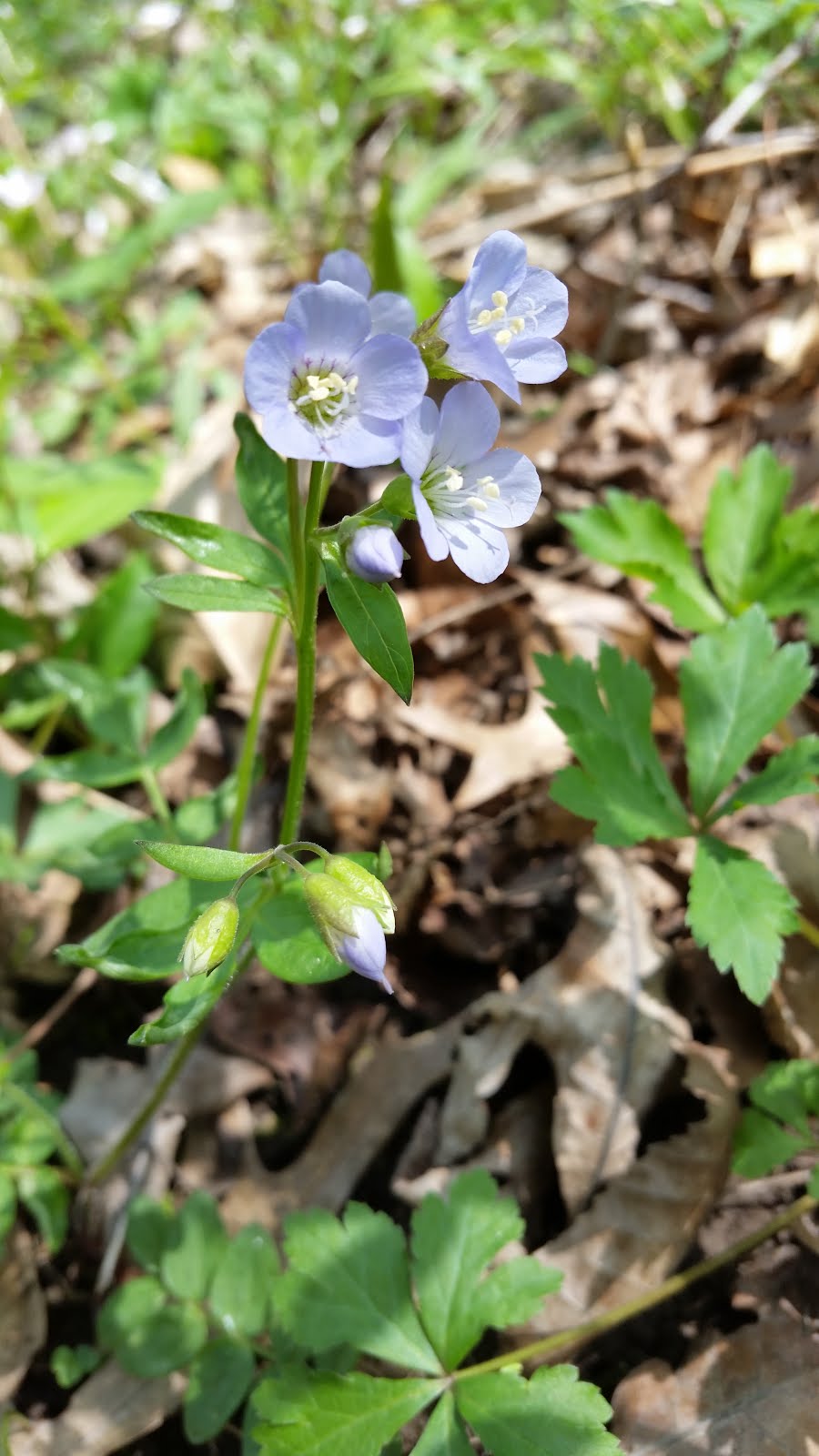
Interspersed among them, Sweet William, Bluebells, and Violets in shades of deep purple, magenta, pale lavender and bright yellow.


In the wooded hills dipping down to Pilgrim Creek, the shade-loving wildflowers are in bloom -- Red Trillium with their three splotched leaves and three burgundy petals, white Trout Lilies like shooting stars, white Anemones with their scalloped leaves, and glossy Buttercups with fringed leaves.


Trout Lily is a strange name for a flower that looks like a shooting star. Erythronium's common name is based on the appearance of the leaf, shaped like a speckled trout. Some of the plant's other common names are equally odd -- Adder's Tongue, Dog's-tooth Violet. Fawn Lily comes closest to describing the graceful blossom with its spotted leaves.


One entire hillside looks like a green sea with shiny waves -- the dark green umbrellas of May Apples glinting in the sunlight, each single lime-green flower bud curving down from the junction of its pair of protective leaves.


The Wild Plum blossoms are fading, but now the Redbuds are in bloom, their small pink flowers popping like pompoms directly out of the bark, with baby heart leaves at the tips of stems. Our neighbor's honeybees are hard at work with all this bounty of blossoms.


Now the Buckeye flower buds have opened. On the Ohio Buckeyes (Aesculus glabra) with green leaves and chartreuse flower cones, tubular yellow blossoms sport curvy white filaments tipped in orange that extend fan inch beyond the lips of the flowers, giving the long cone a bottlebrush appearance. On the Red Buckeyes (Aesculus pavia) with rosy racemes, the clusters of blossoms are cherry red.


Sadly, many of the Buckeyes down by the creek have wilted leaves. Not yellow or brown-edged, just dark green and drooping. It's the first time in the two decades we've lived here that I've ever seen this. We've had plenty of rain, so it could be a reaction to too much moisture in the soil. I hope it is not a wilt leaf disease of some sort, perhaps caused by the soil fungus, Verticillium. So far, the five young trees growing on high ground near our house show no signs of leaf wilt. But it would be a major loss if the creek's stately stand of Buckeyes died. But what to do? Wait and watch, so often the only thing that can be done.

Sunday, April 17, 2016

a host of angel wings


a host of angel wings 
ascending from the earth
from where they arose

The woods are filled with bright blossoms. Dutchman's breeches sprinkled everywhere under the trees, like spring snow. To me they look more like little lanterns with yellow flames swaying from red poles or like angels ascending, or maybe descending, on white or pink wings.


A small woodland flower with clusters of white bells flourishes among the dutchman's breeches, adding more spots of white to the dark leaf litter.


The wild plums are in full bloom, their fragrant scent wafting on a warm breeze as I walk to the mailbox.


Colonies of may apples poke their green skull buds up between the hunched green shoulders of their cloaking leaves.


The leaves undergo fantastic contortions as they unfold.


One may apple wears an oak leaf as a parasol.


Pale green-gold plumb bobs dangle from a hazel bush amidst the baby leaves.


On another understory tree, fantastic gold and red tassels drape along the twig below a fanfare of new leaves at the tip.


But this intrepid plant, literally busting a chunk of hard road clay, takes the prize for determination to grow.

Saturday, April 16, 2016

sunset struck golden


sunset struck golden
buckeye leaves unfolding
upholding green raceme

Every Spring it's a surprise and a delight to find the bare branches of buckeyes along Pilgrim Creek bursting with leaves in all stages of unfolding. The leaf buds look like fat candle flames, red, yellow, green.


Leaf buds appear anywhere on the tree, from branch tips to springing directly from the thick bark of the trunk.


Urged by sun-warmed sap spreading through the tree, the red-tipped scales relax their shielding and part to reveal the leaves packed tightly inside. As the leaf bundle pushes up, the scales curl down like a ruff and eventually drop off. 


The leaves unfold, intricate as origami, twisting, spiraling outward. Amazingly, several leaves are stuffed into each tiny duffel. The process reminds me of a butterfly emerging from its cocoon, spreading its wings to dry.

T


Finally unfurling into five-fingered leaflets, first drooping like relaxed hands. 


On one leaf I find a wasp wandering around, perhaps attracted to some sticky residue on the new leaves.


As the leaves grow, the leaflets broaden and flatten out.


The colors range from lime gold to lime green, rust to burgundy, with subtle shades of copper.


On one tiny stem I find russet leaves streaked with fuschia.


On another, the leaves are crinkled, contorted, blotched with cyan yellow, lime green, ochre.


On the female trees, some, but not all, of the whorls of leaves embrace a raceme that looks like a green pinecone.


The flower cluster also grows, lengthening, swelling, until the flowers pop out. I am taking this walk during the third week of April. The full flowering will take another couple of weeks. Some of the racemes are green, some pink, probably different variety, of which there are many.


When the blossoms burst forth, around the first week in May, they are as amazing as the leaves, which by this time have turned a rich emerald green. 


And then of course, there are the strange buckeye pods, with their protective bristles. They also undergo a fascinating transformation, but that's not until late summer into autumn.


Prickly nut pods on a tree. In August the leaves are already beginning to turn yellow, getting ready to fall.


In October the thick-skinned pod that has been protecting the nut begins to split, like an eye opening.


Whose eye? The dark brown eye of a buck. The ones that don't get eaten by squirrels will lie on the ground, splitting open in the spring as a sprout emerges to start a new tree. So the story of the buckeye comes full circle.