Showing posts with label Iowa landscape. Show all posts

Tuesday, November 3, 2015

rogue cornstalks flutter


rogue cornstalks flutter
above a field of rattling
soybeans ripe for harvest

Driving after dark on our back country road, we see monstrous bright lights in the fields, combines harvesting hybrid corn and soybeans. This morning I pass a field of soybeans, their monochrome brown punctuated by rogue cornstalks sticking up like standards in a battlefield. 
          Kernels from the ears of hybrid corn are not used as seed because the offspring of these plants do not resemble their cross-bred parents. Nevertheless, some kernels from last year's corn crop have managed to survive harvesting, harrowing, freezing, tilling and the planting of soybeans to pop up at random in an otherwise unvarying landscape.


In another field planted with corn, the stalks form dense rows of rustling dry leaves. Farmers in this area grow two cash crops, corn and soybeans. They usually rotate the two crops on their fields in alternate years. This is because grass crops such as corn are unable to take nitrogen from the air, so they need nitrogen in the soil. Legume crops such as soybeans have bacteria on nodules on their roots which take nitrogen from the air and fix it into the soil. So the corn planted the following year is able to use the nitrogen provided by the soybeans. 
          Of course, many farmers also add chemical fertilizers containing nitrogen to the soil. Farmers who maintain large hog contained animal feeding operations (CAFO) will collect the swine manure in pits and then spread it on fields. However, pig manure is very low in nitrogen as well as incredibly stinky!


This field was harvested all night, ahead of a rainstorm. Both corn and soybeans must be quite dry in order to be stored in silos and transported by rail. But rain after a harvest is welcome for refreshing the parched soil for next year's crop. 

Wednesday, March 16, 2011

one lone gray duck swims


one lone gray duck swims
away tracing a blue V
in the pink water

The Canada Geese have vanished and the ponds seem strangely empty after seeing dozens of them crowding the water and shores. Then yesterday a new wave of migrants appeared, half a dozen ducks dabbling and dipping on Osage Pond. But this morning in the rosy light of dawn, only one lone duck remains. From the white speculum it looks to be a Gadwall, one of the most common migratory puddle ducks in the Mississippi Flyway. The gray duck swam away when I stopped, tracing a beautiful blue V in the reflection of pink sky on the still water. Somehow, this singular duck creates a more intense feeling of loneliness than a completely empty pond.

Thursday, March 10, 2011

glistening mud banks


glistening mud banks
sculpted by water into
voluptuous curves

The banks of Pilgrim Creek are marvels of mud laid down in delicately striated layers, wet and shining in the sun as it suddenly breaks through clouds.

copper-gold sunset


copper-gold sunset
burnt sienna big bluestem
between field and road,
remnant of prairie thriving
on strips of unbroken ground

Before the steel plow, big bluestem was one of the most common perennial bunch grasses in the tallgrass prairie that covered the Midwest. Big bluestem can grow as tall as three meters. The roots go deep, sending out tough rhizomes which form an incredibly strong sod. In an area devoid of trees or rocks, early settlers used blocks of sod to build their first dwellings, called “soddies.” This sturdy grass, along with its cousin, little bluestem, is so called because the new shoots in spring turn blue-purple at the base. In autumn the grass turns a deep orange, forming a colorful stand throughout winter. Big bluestem is also called “turkey foot” because the seed heads have three spike-like projections. Big bluestem frequently grows in isolated clumps along roadsides where the ground is undisturbed. However, to flourish, this prairie grass needs occasional fire, either set by lightning or by humans, to eliminate competing trees and shrubs.

Monday, March 7, 2011

beyond the thorn tree


beyond the thorn tree
and barbed fence, three black horses
watch geese winging north

Solid grey cloud cover but no rain or snow. The Canada Geese come and go in small flocks of eight or ten or twelve. They fly in pairs, shifting from straight dotted lines to apexes to ragged clusters. At dusk they land on a convenient pond for the night, then fly on the next day. The geese fly silently, but even so, the horses look up as they pass overhead, winging north. Then the horses return to cropping dry grass in their enclosure.

Sunday, March 6, 2011

blue clouds penetrate


blue clouds penetrate
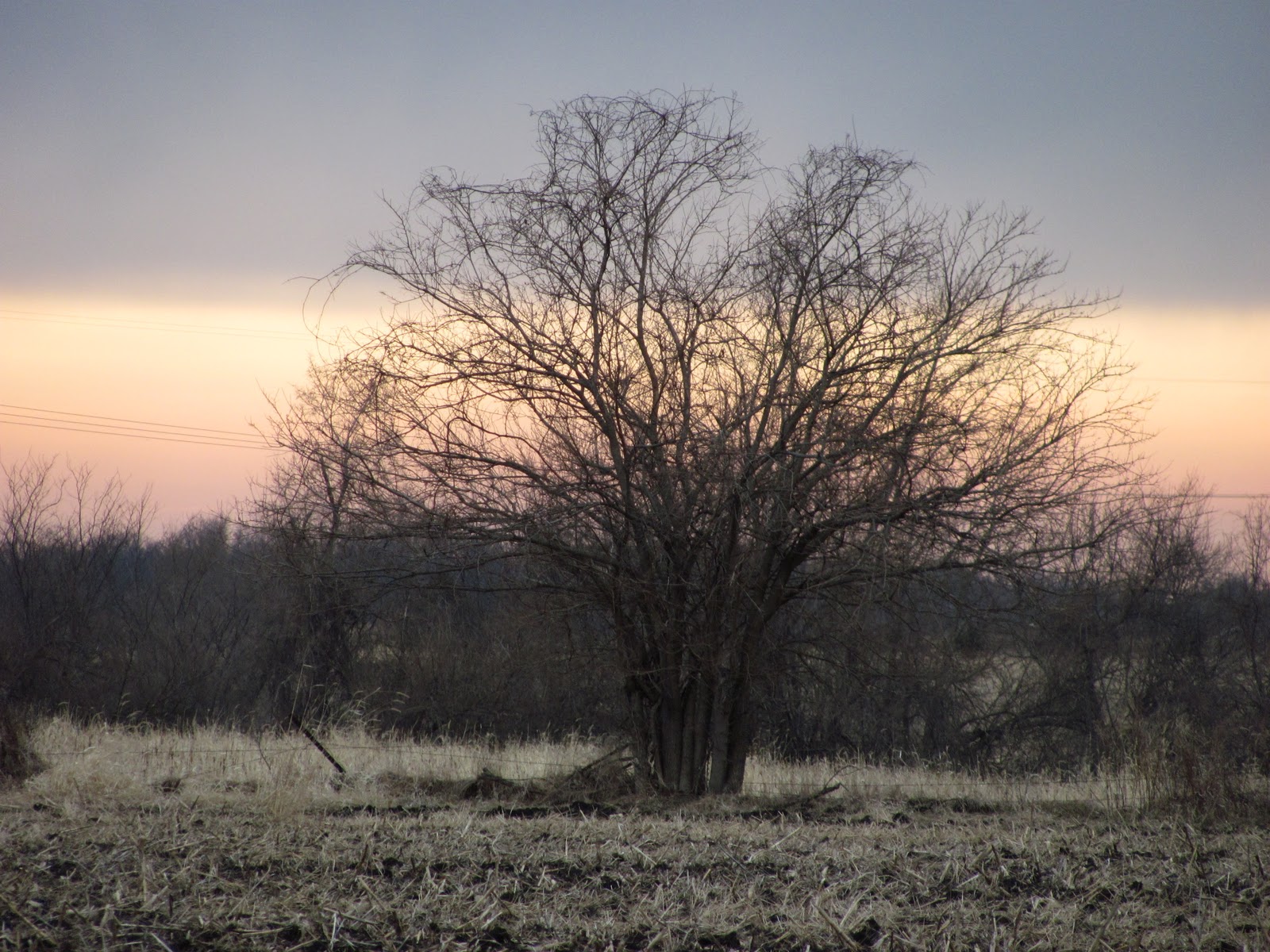
pink sky with fragile virgas –
embracing bare tree

A band of blue clouds spans the horizon, trailing fragile virgas that penetrate the pink ribbon of sunset sky, but the rain fails to reach the ground. Between the darkening clouds and the lingering light, a solitary bare tree spreads its limbs, embracing them both.