Sunday, July 17, 2016

a purple heart


a purple heart
in the center of a lace doily --
invitation to alight

My attention gravitates towards anomalies. In a field of clover I will spot one with four leaves (or five or six). On a page of text a typo will pop out like a red flag. So it is that in a large colony of wild carrot blossoms, I stop at the one and only one hosting a large purple heart in the center of the white lace doily that makes up the multiple flower head. Perhaps the red tone acts like a flag to insects -- alight on me!


A few flowers sport a spot of blood red in that center point, but only a drop. The red dot indicates that these plants belong to Daucus carota, "parsnip carrot," an import from Europe, where it is called Queen Anne's Lace. Queen Anne of England was adept at making lace and the red dot is likened to a drop of blood when she pricked her finger with a needle.


These newly opening blossoms have both red hearts and pink flowers around the perimeter. When fully open, each umbel has 20 clusters.


The vast majority of flowers in this area display a completely homogeneous arrangement otiny white blossoms arranged in a radiating pattern of ever-larger clusters within the compound umbel. The lack of a red center identifies them as American Wild Carrot, Daucus pusillus, "parsnip puny." They are smaller than their European cousins, with only 5-12 clusters, and sometimes have pink flowers, but otherwise they look the same. it's interesting that there is a mixture of the two species within the same colony.


Young blossoms reveal the pinwheel stems that end in small bouquets.


A view from the side shows the curved stems, like the ribs of a parasol.


Here we see the spiky undergirders that support this elaborate structure.


It is this basket that protects the emerging blossom.


And then encloses the collapsing flower as it becomes a fist of seeds.


Which turns into a brown rattle, ready for the bristly ribbed seeds to drop to the ground in the spring.


In a colony of Daucus, all stages of growth from bud to seed may be going on at the same time, a good way to ensure the greatest chances for pollination and seed dispersal. No wonder this wildflower is so abundant. The perennial white root of Daucus carota smells like a carrot and is edible, especially in the first year. The long root withstands mowing to send up new shoots in the spring, while the prickly seeds easily propagate. 


Farmers consider it a noxious weed because it out competes native grasses for resources, it may be slightly toxic to livestock, making them "nervous," and it may taint the milk of dairy cows that ingest it. Some indigenous tribes ate the root, so this might be a good way to cull out unwanted plants. After all, they are probably the ancestors of cultivated carrots.

Saturday, July 16, 2016

border between wild


border between wild
and tame, honeybee harvesting
wild carrot nectar

On today's walk, as I pass a colony of wild carrot I spot a honeybee crawling over one of the large white "lace doilies." She's probably a worker from one of my neighbor's hives. Even though she looks like a wild insect, she goes home to a box, so she's slightly domesticated. The Queen Anne's lace, on the other hand, is thoroughly wild. Although beautiful, it doesn't make a good cut flower and its invasive habits make it less desirable as a cultivator. But here the two are, happily coexisting, the wild and the (slightly) tame. The honeybee will just as willingly pollinate my fruit trees and berry bushes as the wild flowers that abound around here.

I come home to my box, full of windows. The whole south side is an expanse of glass that fills my eyes with green as I sit at the table, enjoying a dish of peaches from last year's harvest. Opening the mail, I leaf through Time magazine, trying to avoid the pictures of suffering.

What's this? Stuck in the middle of the world's craziness, an article on the healing power of nature (Alexandra Sifferlin, Time, July 25, 2016, pp. 24-26). Studies done by Japanese scientists have proved that the practice of shinrin-yoku, "forest bathing," lowered the stress hormone cortisol. The beneficial effects of spending time outdoors are probably due to a number of factors: fresh air, effortless attention, mood elevation, feelings of awe and a natural tree fragrance called phytoncides that lowers blood pressure and increases the number of white blood cells that support the immune system. Even looking out the window at green trees has a healing effect.

Reading this makes me reflect, as I do every day, on how fortunate I am to live in the midst of nature. Our house is surrounded by a little strip of overgrown permaculture garden, a small mowed clearing around the sheds and cars, and then the woods. Even when I walk to the mailbox on the gravel road, I pass along a corridor lined with a generous margin of wildflowers and then the wild woods that stretches for acres, full of trees, bushes, more wildflowers, a wandering creek and lots of wildlife, including deer, fox, wild turkeys. if I go into town, a ten minute drive, the blacktop is bordered by deep ditches filled with wildflowers and copses of trees between the cultivated fields. In town, the streets are lined with trees, each house has a green lawn and parks are interspersed between the houses.  

I grew up in the older suburbs of several big cities, so we always had a yard, a garden, fruit trees, once, a creek at the end of a dead-end street, once, a whole lake across the street. Vacations were always to a location with even more nature -- Big Springs and the Johnson Shut-ins in the Missouri Ozarks, Lake Winnipesaukee in New Hampshire, nearly every national park.

I realize not everyone can live in the country. If they did, there would be no country. So I am happy that most people live in cities. My wish for them is more urban green spaces, whether it's a tree-lined avenue, a park on an abandoned rail line or a garden in an empty lot. And I pray that we will always preserve our national parks and wilderness areas, where as many people as possible can come for forest bathing.

Thursday, July 14, 2016

delving into pink


delving into pink
tubular bee balm flowers
fumbling bumble bee

Another thunderstorm approaching. No honeybees in sight near my neighbor's hives. But their fat, furry cousins, the bumble bees, are leisurely working the bee balm along the verge, sometimes two on one blossom. 


Their long tongues, curled up during flight, are able to extend down the tubular flowers that cluster in each pink pom pom, whereas honeybees, with their short tongues, prefer open flowers, like this bowl-shaped blossom.


The two types of bees differ in a number of ways.There is only one species of honeybee, which originated in Europe, while there are dozens of species of bumblebees. 

Honeybees live in large above-ground hives of 50,000 to 60,000 bees, where they store honey in wax combs for food all year long. Honeybees communicate by waggle dancing to show the location of nectar. A honeybees that stings will die, as her barbed stinger sticks in the skin. The queen can live three to four years, over-wintering with many of her worker daughters. An older queen may leave her hive and swarm with over half of the worker bees to start a new hive. Beekeepers try to capture these swarms and place them in a new hive.


Unlike honeybees, bumblebees live in the ground in small nests of 50 to 400 bees, producing only a small amount of a honey-like substance which they eat. They may communicate by passing pollen between workers. They can sting more than once, but only if aggravated. The workers only live a few months, while the queen lives for one year, hibernating in a hole. No wonder the bumblebees are busy!

The different species of bumblebees have different lengths of tongues, so they feed on different shaped flowers. Here one is crawling on the platform under the overhanging "lid" of an iris petal.


This bumblebee, its legs laden with pollen, is plunging into the center of a rose.


A bumblebee in flight sips nectar from a bell-shaped sage blossom.


This buffed fellow is meticulously probing each of the tiny tubes of a coneflower.


The bumblebees delving into the bee balm (Monarda fistulosa, also called wild bergamot, horsemint and Oswego tea), are inadvertently pollinating the plant. This native plant has many medicinal uses, due to the antiseptic compound thymol found in the plant's leaves and buds. It has a minty fragrance and taste, though a bit bitter. Indigenous Americans as well as later settlers used the plant for everything from seasoning meat, to treating wounds, throat infections, headaches and fever. After the Boston Tea Party, the rebellious Colonists substituted Oswego tea for British tea.

Honeybees, mostly domesticated, are threatened by mites, diseases and pesticides. Bumblebees, which are wild, are threatened by loss of habitat and also by pesticides. Fewer pollinators, fewer flowers, fewer food crops, not a fun scenario.

Sunday, July 10, 2016

Queen Anne's lace curving


Queen Anne's lace curving
down, droplets beading long stems --
soft sweet summer rain

Just as I open the door to walk to the mailbox, a gentle rain is falling. Good time for a stroll in the cool freshness under a big blue and yellow umbrella. Along the road a patch of Queen Anne's Lace bend and sway, rain drops beading along the long stems.


Other wildflowers with thin stems are also stooping almost to the ground.


While the sturdy stems of milkweed stand erect. Sadly, I have seen nary a Monarch butterfly this year.


Bee balm in bloom now, but of course the honeybees are holed up in their hives during the downpour.


A lone wild rose blossom, dappled with rain drops.


Trees are also producing flowers, dangling beneath a canopy of wet leaves.


I feel like I'm walking in the jungle, such profusion of greenness, glistening, wet, wild, like this wild grape vine.


Everything is in a hurry to grow, grow, grow, soak up the rain into the roots, make chlorophyll with the ever-expanding leaves while the sun shines, produce flowers, bear seeds, now, now, now!

Friday, July 8, 2016

pink and gold rings curving


pink and gold rings curving 
out across a farm pond --
bridge of blue clouds

Hard rain in the morning of the seventh day of the seventh month, but clear by noon. At 9:15, just before sunset, a few blue clouds in the west.


I drive quickly back from town to a hill overlooking a farm pond near our house to catch a spectacular sunset.  


Fish rising to the surface create pink and gold rings curving out and out across the placid water. A bridge of dark blue clouds arches above the golden sunset, but no rain. Surely Vega and Altair, the star-crossed lovers in the Japanese Tanabata legend, will be able to cross the Milky Way tonight.

Thursday, July 7, 2016

star festival -- children's


osanara no
kasari kaketaru
hitomoto no
sasa ni tusure naki
tanabata no ame

star festival — children’s
wishes on colored paper 
tied to bamboo trees —
sadly rain prevents star-crossed 
lovers their one chance to meet 

When I was in Japan last month, my hostess, Goto-sensei, kindly gave me her sumi-e (ink wash painting) of a tanka (five-line poem with 5-7-5-7-7 syllables) written in her graceful sosho, (cursive shodo or calligraphy) about the Star Festival. Together we translated the waka (poem) into English. Goto-sensei did not know who the author of this particular poem was. Man'yoshu, the oldest existing book of poetry, contains many poems about the legend behind the Star Festival, and Kaknomoto no Hitomaro wrote 137 poems about Tanabata.

Tanabata, the Star Festival, is one of five traditional seasonal festivals, or gosekku. It is celebrated all over Japan on the evening of 7 July. The festival traces its origins to a legend about the stars Vega and Altair in the constellations Lyra and Aquila, respectively. According to the ancient Chinese legend, Hikoboshi (Altair), the cowherd star, and Orihime (Vega), the weaver star, lovers separated by the Milky Way, are allowed to meet just once a year  on the seventh day of the seventh month.

According to the folktale, Orihime, a gifted weaver, the daughter of Tentei, the king of the sky, wove beautiful cloth into clouds on the bank of Amanogawa, the heavenly river. She worked hard to please her father, but she was sad that she could never meet anyone to marry. 

One day Tentei allowed her to have a day off. Wandering along the heavenly river, she saw Hikoboshi, a cow herder who lived on the other side of the Amanogawa. His cows provided the milk for the Milky Way. They met on the only bridge crossing the river and immediately fell in love and got married. They were so in love that Orihime stopped weaving and Hikoboshi allowed his cows to wander all over heaven. Tentei became angry, destroyed the bridge and forbade them to meet. 

Despondent at the loss of her beloved, Orihime wept all day. Moved by her tears, her father agreed to let them meet once a year on the seventh day of the seventh month (seven being a lucky number), as long as they both worked hard during the rest of the year. 

Of course, the first time they tried to meet, they could not cross over because there was no bridge. Orihime cried so much that a flock of magpies agreed to make a bridge with their wings so she could cross the river. Unfortunately, if it rains on 7 July, the river floods and the magpies cannot come, so the star-crossed lovers must wait another year to meet.

During the Star Festival, children and adults write their wishes on tanzaku, long, narrow strips of colored paper which represent the weaving of threads, and hang them on bamboo branches placed in the backyards or entrances of their homes. They then pray for good weather so that they can catch the reflection of the two stars in a tub of water, the sign that the two lovers will meet and their own wishes will come true.

Wednesday, July 6, 2016

curving back in bursts


curving back in bursts
of blue red white supernovas
this calm summer night

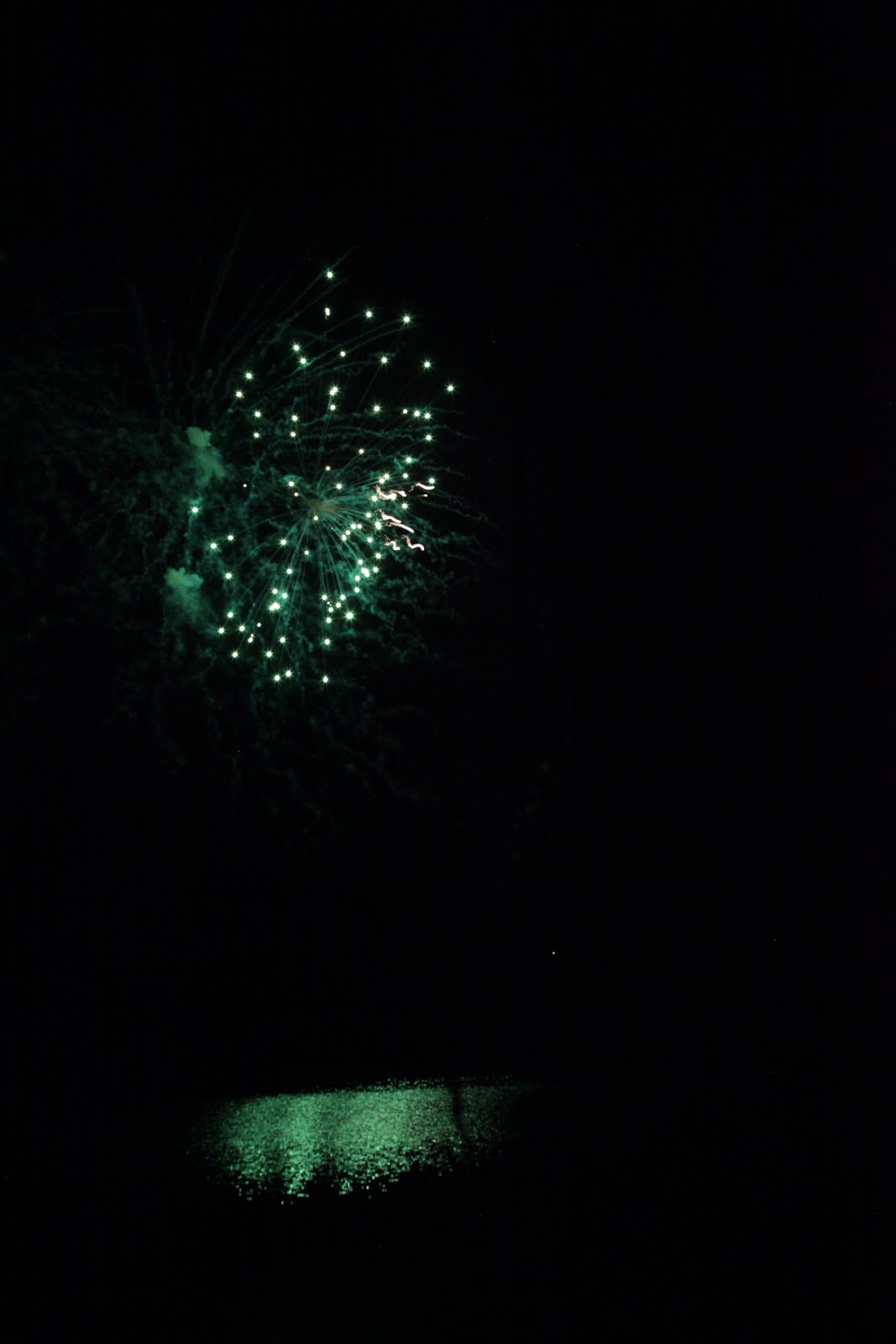
We arrive on the northwest side of Pleasant Lake for the July 4th celebration in the late evening. Good thing we came while it is still light because we have to wade through boot-sucking mud. Most folks are sitting on blankets or camp chairs on the beach on the southwest end of the lake, but I want an unobstructed view for my camera. While I set up the tripod, mosquitoes bump against my face, thankfully discouraged by herbal repellent. Then we wait for it to get dark. Suddenly, the sky across the lake bursts with sound and light, shimmering reflections in the water.


The finale comes all too soon, a cacophony of rapid-fire multiple explosions layered one on top of the other. Then silence. Is it over? The crowd at the end of the lake cheers and claps. Yes, it's over for another year. We turn on our flashlights and slog back along the swampy path, eyes and ears still dazzled by the show.